I came across an article by Aradhya Jha (shared by Kai in Dense Discovery), where she takes a swing at minimalism:
Minimalism is a form of neocolonialism and Western cultural hegemony.
That caught my attention.
A preference for clean lines and neutral colours supposedly suppresses the rich ethnic traditions of the East. She references Said and Western "chromophobia", calls minimalism "fascist", and calls for resistance through maximalist self-expression.
Well, that's not everything she writes about it. Let's roast minimalism a little.

Last updated: 30 April 2026
Minimalism as Western neocolonialism
Look, if she had written this seventy years ago, fair enough. If colonial rule forced its architectural style onto people and used it to suppress local expression — that's obviously not okay. But today?
If we set aside the political charge, minimalism can also just be about a living room and architecture:
- If richly decorated architecture sparks creativity, that's fine.
- If bare walls spark creativity, that's fine too.
It can go wrong when:
- The things around me don't come from me.
- I'm doing something that doesn't fit me and doesn't affect me positively.
- It gets in the way — even mentally (an overly decorated home can do that too).
And what about the claim that less is boring?
Maximalist trends — less is boring
Aradhya looks beyond architecture.
"Maximalist trends embodying the principle of 'less is a bore' are gradually making their way into areas such as makeup, fashion, and interior design. Bold patterns and vivid colour palettes are finding their way back into the mainstream. Building such a counterculture is a necessary and refreshing step toward disrupting dominant narratives."
Aradhya has fallen into her own trap. The trend doesn't matter. As The Minimalists say:
It's about choosing timeless over trendy.
Trends are an external force — nobody wakes up with an innate desire for a capybara t-shirt. The capybara has to be sold to us by marketing.
Minimalism is about knowing your own needs and resisting trends. Consumerist life leaves many people unsatisfied, and instead of endless options, they choose less.
Minimalism is one of those choices.
But Aradhya pushes harder and brings in arguments about fascism.
Minimalism as fascism
Aradhya uses a quote from Italian architect Fabrizio Casiraghi:
"Take the straightforward statement of Italian architect Fabrizio Casiraghi: 'I think minimalism is fascism, because it forces you to live in a very unnatural way. You are a prisoner of the order you have built to maintain the perfect shape of your home.'"
No and no. If we're prisoners of our own order, that's clutter. Rules that make life harder aren't minimalism.
Minimalism as a necessity
Aradhya, minimalism is unavoidable in today's Western world. Without it, we stumble around like someone blindfolded with a backpack full of rocks.
Never in history:
- Have we been able to buy so many things.
- Have we done so many activities.
- Has so much information been thrown at us.
- Have we had to learn how to be bored.
For me, minimalism is a path. To maximise what matters (to us).
Digital Minimalism: It's Not About Fewer Apps. It's About More Life.
I thought I knew something about digital minimalism. Then I read Digital Minimalism by Cal Newport.
In the first chapter, he told me that my routines only stop "an uncomfortable feeling of losing control".
Ouch.
Hey, if you don't want to read the whole article, the golden nugget of everything I write today (and also a summary of the book) is this:
Our main goal is not to use fewer apps. It is to go back to what we really are. What do we enjoy? What will we do instead of social media? Reading, writing, knitting, walking?
Last updated: 27 March 2026
Digital Minimalism as an Answer to Losing Control
Tools that limit time on social media are useful, but they are not enough. We need to change how we think. Goliath is really strong.
It is true that if I did not use browser extensions to hide feeds on YouTube, Facebook, and Instagram, I would be like everyone else. 🤔
We are fighting against millions of dollars invested in studying human behavior and turning it into code. The goal is to keep us on these platforms longer. The more we give them, the more money for their owners.
According to Cal, people use their phones compulsively to hide the emptiness they feel when they cannot fill their free time.
Oof, that was not easy to admit.
I write books, blog posts, I read, run, do yoga, meditate, cook, and ferment. I thought I had Facebook and Instagram under control. And then every evening I stared at my phone looking for more apps with new things to read.
Filling the Emptiness
Only when we bring the joy back into life — joy that slowly went away — do we want to spend more time on the things we rediscover. We notice that we feel better doing them than when we fall into a virtual rabbit hole.
We try to make technology support the things we care about. We use YouTube to find knitting tutorials, recipes, how to fix things, whatever.
Technology is great. We just have to tame the horse, not become a tamed horse ourselves.
20 Books a Year Means Reading 38 Minutes a Day
Do you want to read more? Say how many books you want to read in a year.
How many? Twenty? Then 38 minutes a day is enough, dear reader.
Where will you find those minutes? Take them from social media!
An average novel has about 350 pages. Reading one page takes about two minutes → 350 × 2 = 700 minutes per book × 20 books = 14,000 minutes a year → 14,000 / 365 = about 38 minutes a day.
We Will Not Miss Anything
A common reason for checking Facebook (or another app) many times a day is that we sometimes find useful information there. But think about the ratio: write down how many posts actually helped you, then divide that by the total number of posts you saw in that time. What number did you get? One percent?
If we connect once every two days for 10 minutes on a computer, I do not think we would lose that 1%. What we would not lose is dozens of minutes of time and energy spent comparing ourselves to others:
- (for women:) comparing yourself to a classmate's gym photos.
- (for men:) comparing your partner to her classmate.
- (for both:) comparing your neighbor's car or their all-inclusive holiday by the sea.
"A new user who got an iPhone in 2007 for its music features would probably not be happy to learn that within ten years they would compulsively check their phone eighty-five times a day — a 'feature' that Steve Jobs certainly did not think about when preparing his famous presentation." A quote from Digital Minimalism by Cal Newport.
Efficient Communication, Not a Replacement for Meeting People
Cal does not suggest getting rid of smartphones or all apps.
It is enough to keep only the apps that serve something important to us. Important — not just useful in some vague way.
According to Cal, technology should be used for making it easier to arrange meetings in person — not for replacing those meetings and conversations.
Wow! That is the silver nugget (the gold one is at the top).
What Changed After Reading the Book
After reading Digital Minimalism, I:
- deleted from my phone:
- Facebook — I now only use it on a computer.
- Discord, which I eventually forgot about completely.
- Slack, which I open once in a while (I have a few clients there, or rather they have me 😅).
- Degiro (an investment app), where I used to watch how my investments were doing and look at charts for too long. Now I check Degiro about six times a year. I do not think about how stock ETFs are performing — I just let them be, as a good passive investor should.
- I kept Instagram because I can use it to post on Facebook at the same time.
- On my computer I keep using feed blockers.
- On my phone I still limit the time I spend on Instagram.
These changes gave me back about half an hour every day. And also a lot of energy that used to go into falling down the rabbit hole of comparing myself to others (I do not follow my partner's classmates on Instagram — I only have an author profile, and for some reason other authors never post things like that 😅😅).
Now, before I install any app, I think about whether I really want it on my phone. If I do, after installing it I turn off all notifications (seeing things inside the app is enough for me).
I am thinking about turning my six-year-old Nokia into a spare phone for:
- a backup when traveling
- a "dirty" phone where I would have Instagram for posting to my author social media profiles. My main phone would have none of that.
Practical Tips for Starting Your Digital Minimalism Era
Digital minimalism will not come by itself. Do not wait for someone else to do it for you. And do not rely on government rules! We have our own heads. Take an hour for yourself. Go to a café, take a pen and a notebook, and do a digital audit. Also write down the activities you would do if you had more time.
Digital Audit
Find the apps:
- That distract you the most.
- That you spend the most time on during the day.
- That you keep "just in case they might be useful one day".
Create Offline Routines
Keep writing. Rediscover your hobbies. Write down the activities that make you feel good. What would you do if you had more time?
Take Action
Delete the distracting apps. Visit them on your computer at a fixed time or with a clear purpose (checking local events, reading updates in a group you like, …). For the apps you keep, turn off notifications.
Take Care of Real Relationships
Next time you want to like or heart something, think about whether you could message that person and meet them in real life instead.
One hour outside with someone is worth more than thirty-three likes. Actually, more than forty-two.
And write to your favorite online creator here — it gives them the energy to keep making things (wink, wink).
Six-Month No-Planning Experiment
Do you want to go to the tea house tonight? Yes? Let's go. No time? Maybe another day.
This was my six-month experiment. No planning. And when I do plan, I only put things in my calendar when I am sure about them.
What did I find out?
- I feel less pushed around and more in control of my time.
- I have more spontaneous moments of joy.
- Not planning can be hard when people around you do plan.
- I accepted that I will see some people less often.
- I used to love a full calendar. Now it feels scary and limiting.
Last updated: 13. 3. 2026
Where the no-planning experiment started
I was inspired by simple ideas like:
- Would I say yes if this happened this weekend? No? Then why say yes to something six months away?
- One yes means no to everything else at that time.
- No is a full sentence (I first read this in Magda Čevelová's newsletter).
One yes means a hundred nos
How many times has a friend called me: "I happen to be passing by, can we meet?" "I'll be in town next week, what if we…" And I couldn't. I already had something in my calendar. Something I didn't even want to do. Either I cancel what I promised, or I miss a better moment.
And what if it's not easy to cancel? I get stuck. I waste mental energy.
You can prevent this -> don't plan ahead.
Make plans with a friend only a few days before.
A rare opportunity is not only a friend visiting. It can be a concert, a talk, a workshop, something you really want to go to...
Just one chocolate from the box
I write events I would like to attend in my calendar, but I don't confirm them. When I have three things on the same day, I set priorities. And I choose only shortly before the time comes.
Some things you have to plan, right?
Do I really? "I have to get coffee with my friend, I haven't seen her in a long time" can be reframed: "I want to get coffee with my friend, because otherwise she might think I don't care about her." Hmm, that sentence is not really about me at all. Do I care about her? Then I'll tell her about this experiment and ask if she can be patient with me for now. Do I not care that much? Then I'll let her be upset — that's her choice. And maybe she won't even be upset. Maybe the worry is just floating in the air.
But yes, some things I do want to plan. Those are the best chocolates in the box. I just make sure I don't have too many. As someone wise once said: Cheesecake is great. But you don't want to eat it every day.
I keep to the rule of one planned thing per week. And during the week I let other things come as I feel. After all, on Monday I can much better judge whether I want someone to come into my Thursday, if it really has to be planned...
Today is not tomorrow
What about how you feel on that day? How many times have you picked food in a cafeteria for the whole next week and then stared at your plate thinking: "Why did I choose this?" What if you want to do something else that day? Or you are not in a social mood (this happens to introverts)?
Some dates seem to attract more events. Like the end of September or October, when things pile up. I had to be very careful during those months last year. Because after a two-day seminar in Prague, I really did not want to go to an author reading the next day — even just to sit and listen.
How did I start the six-month no-planning experiment?
Two years ago in Las Palmas, the girlfriend of our French housemate said: "You Europeans are terrible. In Macedonia I call a friend to see if they want to go out. And we go. You pull out a calendar and give me a two-hour window next Wednesday."
That conversation stayed in my head. After five months of not planning in Mexico, I came back to Czech Republic and almost fell back into old habits. But I wanted to go write in Sweden. I didn't know exactly where, and I knew it would be sometime in July. I protected July like a mother protects her young. By saying no to events, I discovered I was happy doing it.
The six-month no-planning experiment helped me escape time poverty. Vero and I talked about time poverty in episode six of the podcast, and I also touched on it in the article Do you have time for slow travel? Why fast travel steals our time, from a different angle.
Where does the need for a full calendar come from?
I wonder where this need comes from. Does it start in school? Where we had a set timetable, and someone always told us: From eight to 8:45, maths. Then language, geography, history...
Sit down! Listen! Now do this exercise! Now learn this. Don't think — that's the teacher's job. And the teacher shouldn't think either — that's what the curriculum is for. A good grade just means repeating what the teacher told you. And a good grade means things are fine at home.
As children we got on our bikes after school, rang a friend's doorbell and asked: "Hello, can Pepa come out?" We pulled a friend out of the house. If they couldn't come, we rode to the next house. It didn't have to be efficient. Nothing bad happened if nobody could come in the end.
Maybe a full calendar gives us the feeling that we are using our time well. Busy means successful!
I don't know. The whole thing feels strange to me. I feel like we got lost somewhere and twisted it all around.
Luckily we are grown-ups now. Yay! I'll hug my Tomík, you hug your person, and let's go make our own timetable. We can now!
Similarities Between Creating a Raku Ware and Life
The first ware is more of an attempt. You prefer to smash the clay back into its original ball and start again. This time you take care. Too much. So much that the bowl's walls weaken and hold together by sheer willpower. It would be a miracle if they survived the transfer to the kiln.
Last modified: December 4, 2025
Swallow the Bitterness, Son, and Start Again
When the instructor asks if you'd like to start over after the second attempt, you don't want to. You put so much into that bowl!
You swallow the bitterness and within a minute you pound out a bowl that in your eyes is perfect. In the third attempt, you capitalize on previous failures. By not clinging to the perfection of the second bowl (though unusable), you create the third bowl. Without the previous failures, it wouldn't have come to be. It's not perfect, but it has a piece of authentic beauty in it.
Since you created it quickly, you can make one more. The fourth, created in another minute, looks similar to the third.

Touch
While working on the bowl, you realize how pleasant it is to touch the cold, wet clay. Your fingers, accustomed to pounding on a keyboard, now play with pressure, smoothing, squeezing... There's almost an intimacy to it. And practicality. Under your hands, something emerges that you'll (hopefully) actually use.
You don't add any handles, feet... On the contrary, it's important that in its simplicity it fulfills its function to the maximum: that it fits into your palms and when placed on a table stands (stably).
The Firing Kiln
The resulting bowl is vulnerable, any show of force deforms it. It doesn't hold its shape. Only through passage by fire does it gain strength, simultaneously fragility.
Loss of Control
After firing, the hot vessel is placed into wet leaves and sawdust, which react with the glaze, imprinting their structure into it. If you had control over creation until now, here comes the part where you let go. Nature enters the game. The choice of glaze color has an influence, but depending on many variables, the final appearance will change.


First Tea
The bowl is heavy, sits nicely in your palm. After the first tea drinking though, you know you won't use it for tea. When bringing the bowl to your lips, it bothers you that the vessel's walls are too thick (not that the instructor didn't warn about this during the workshop). A few times you even scrape your teeth against the walls. It reminds you of when you were little, standing on the porch, mom giving you a drink and you bit through the glass...
Eventually you fill the bowl with baking soda and use it for dripping essential oils (see article, where I discuss this use). While writing this article, you have it by the keyboard and inhale the scent of oregano. The second vessel you use for burning palo santo or sage.


What Actually Is This Raku Ware?
What actually is this raku bowl? I won't reinvent the wheel and will copy here a quote from the invitation to the workshop that was organized by the Regional Library in Pardubice.
"Creating a hand-pulled raku tea ware – a two-phase workshop led by the author of the exhibition Memory of Clay Marcela Pospíšilová.
Raku ceramics is a traditional Japanese pottery firing technique that originated in the 16th century and was originally connected with the tea ceremony. It is characterized by the ceramic being rapidly cooled after removal from the kiln – often placed into sawdust, leaves, straw, or water. This process creates very striking, often irregular color effects and cracks (so-called crackle glaze) on the surface."
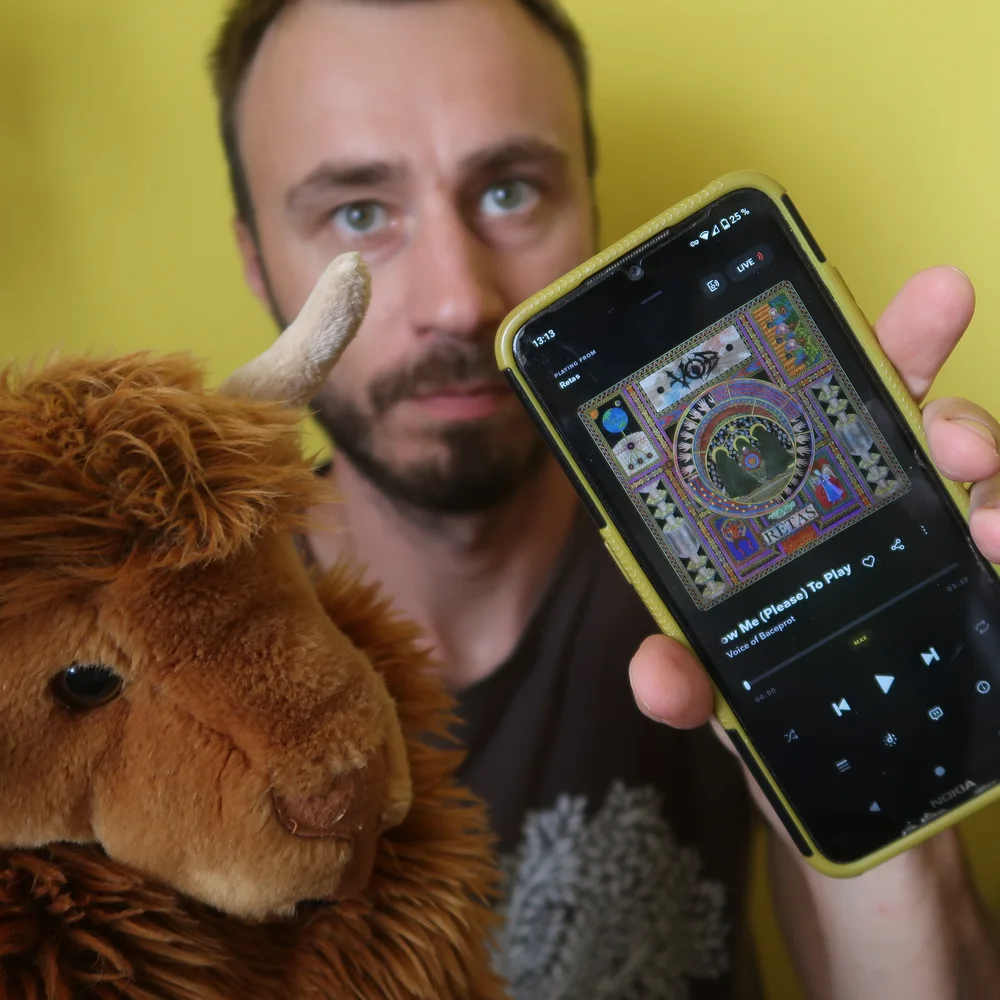
At the end of summer vacation, I was dealing with my approach to music. I can't imagine life without music.
But then something happened that broke my world.
I came across that investment by Daniel Ek, the owner of Spotify, which I've been subscribing to for years and until last week I was devouring it (Spotify, not Daniel).
Last modified: October 28, 2025
In short: Ek got rich running Spotify. He took his 15 billion and invested it in a company called Helsing (clear overview of the case here). But they don't press CDs. They make war drones. And they integrate artificial intelligence into them. The investment isn't one-time - the guy is also chairman of the board.
Note: To lighten things up a bit, here's a catchy Last Goodbye to Spotify by Formidable Vegetable.
Leave Spotify? But what about all those playlists?
I was dealing with the dilemma of whether to stay on the platform. I don't like that war technologies are being financed from my money. That's in conflict with art and my values. For me, art should have a positive note. It should uplift, heal, connect, break down stereotypes and traditions... but not destroy.
What about those playlists I've created over the years? What about that easy access to music?
It was grinding inside me. Similar feelings came as years ago when I was dealing with similar reasons (though there were more of them) leading to my resignation at work.
I started wondering how much Spotify pays artists: about 10 cents per stream. If an average album has 10 songs, the artist gets 1 CZK per album listen. If we take an album with a (lower) price of 200 CZK, we'd have to play it at least 200 times for the artist to break even. Massacre! For example, Tidal pays 30 cents (→ 67 listens). Damn difference.
I cancelled Spotify and switched to Tidal. At the same time, I'll buy CDs and mp3s from artists every month to support them. And build a music collection of evergreens independent of streaming platforms.
I support various creators and writers, but I checked off musicians by supporting them through Spotify and that's enough. Nonsense. Now I know. In the end, I'm glad for that difficult weekend. It hurt, but it was worth it.
Transfer to Tidal
Tidal was founded by artists. Compared to other streamers, it's not such a behemoth. The price of Tidal subscription is +-the same as Spotify.
Registration is simple. After logging in, you'll see something that resembles the earlier Spotify before simplicity disappeared from it (and video and moving podcasts with subtitles appeared, which move without me starting them).
What advantages I see in Tidal over Spotify, you'll read at the end of the article.

Transferring playlists and music
For transferring playlists from Spotify, I used the app tunemymusic. After connecting Spotify and Tidal with the tunemusic app, music is exported from Spotify and imported to Tidal.
Tunemusic is free for up to 500 tracks. Above 500, you can pay 9.5 USD one-time. It's worth it. Otherwise, you'll spend years creating playlists and searching. Out of 318 albums on Spotify, 8 are missing on Tidal. For playlists, I'm also missing about 2-3% of tracks on Tidal. From what I've checked, the missing ones are really "quirky" tracks. I can do without them or buy them as mp3.
The only things that aren't done automatically are:
- Nesting podcast folders - this must be done manually in Tidal.
- Custom folder images also don't transfer.
Reviving old equipment with Tidal
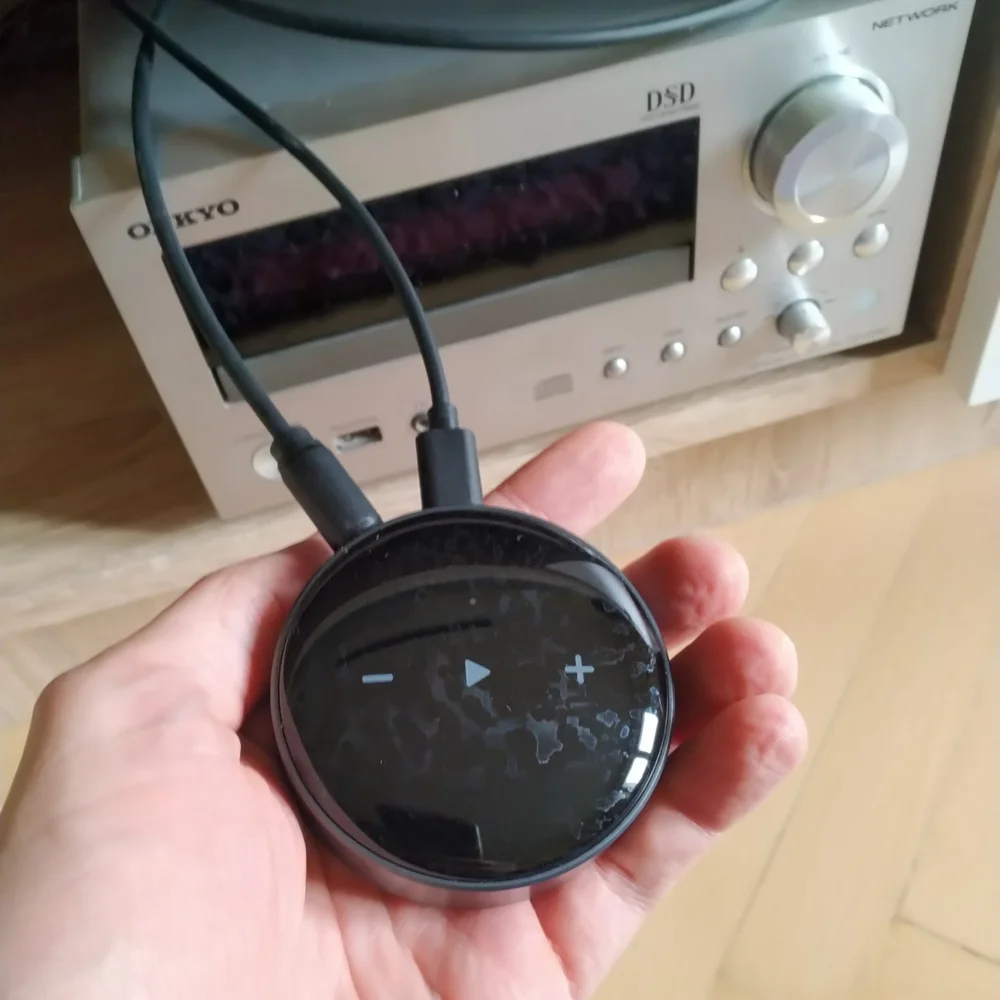
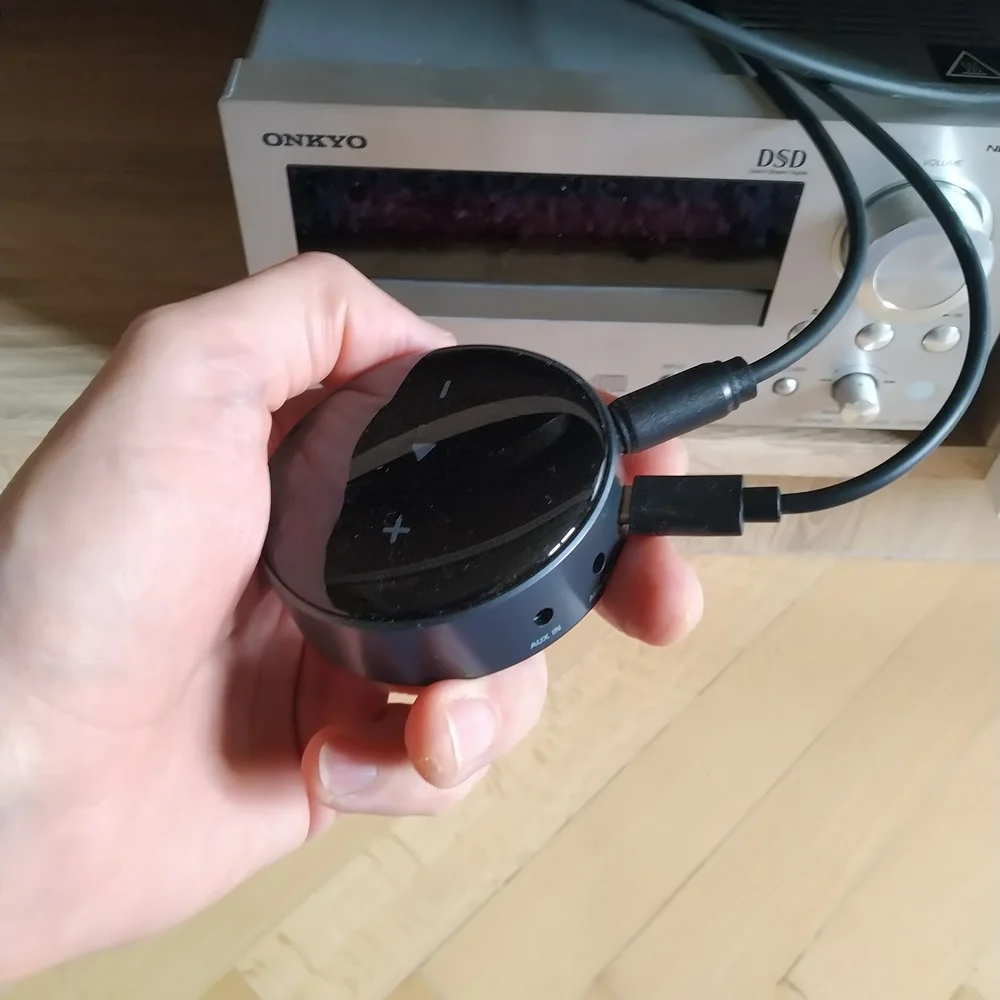
You can buy a network player that you connect to WiFi and to an audio system. I got Wiim Mini for 2700 CZK. It has a 3.5 jack output and higher quality SPDIF (optical output). Cables are included in the package.
Player setup is done through the app. Power is from the included adapter. I power the player from USB on the audio device. This has the advantage that the converter turns on and off with the stereo.
What about podcasts - Fountain
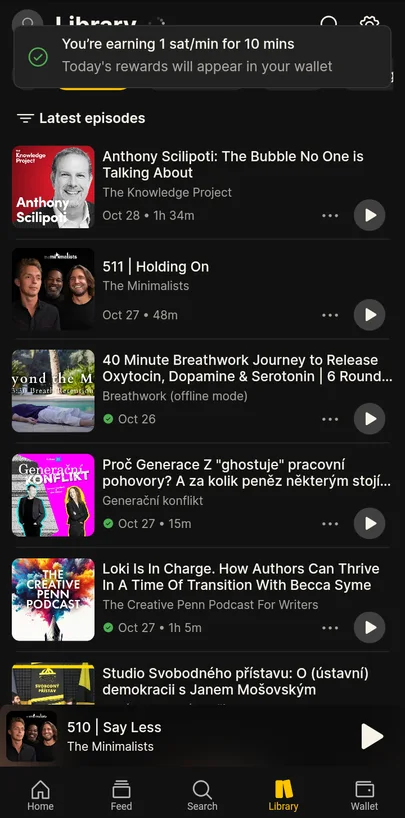
Tidal doesn't have podcasts → need to solve differently. The value4value app Fountain worked well for me. Fountain has its own bitcoin lightning wallet, which you can charge, while at the same time earning sats by listening. You then spend them on direct support for creators. You can set how many sats per minute you want to donate and the app pays according to minutes listened. Or you send one-time support with a comment. Or nothing.
The Fountain app is minimalist and has everything needed. Podcasts can also be downloaded. In the premium version (100 CZK/month) it can also do text transcripts.
How it works for podcast creators
Fountain uses the Podcasting 2.0 standard, which is an open protocol. If you add a podcast RSS through Podcast Index, the podcast is automatically on Fountain.
But beware - if you don't log in to Fountain as a creator, you can't receive payments from listeners. Sats that listeners would send you simply won't arrive anywhere.
Advantages of Tidal
Tidal is beautifully clear and has several advantages:
- Division of albums into regular releases, compilations, and live recordings.
- Sorting by album release (that's divine!).
- Clean and clear web player.
- The very first item in settings is Offline mode.
- It's possible to set stream quality - you see what you're setting (data rate and ADC quantization levels).
- Clips are on the side, don't disturb like on Spotify.
- Missing podcasts -> when selecting music, new episodes don't pull attention, which Spotify also automatically played with subtitles to grab your attention.
- Album cover is full width during playback.
Disadvantages:
- Doesn't have a Linux app.
- Older audio systems with Spotify Connect support are out of the game (can be solved with external device - see above).
- Doesn't have podcasts (yes, it's also a disadvantage).
Questions
After sharing my Spotify subscription cancellation (in Zero Waste Digest), I received a series of questions/comments. The most frequently repeated were these two:
"I only use the free version of Spotify"
Even so, Spotify still makes money from you through advertising. Advertisers pay them for listeners. I'm not judging at all. I'm stating and fully respect a different path. And it's clear that similar conflicts of interest will be on every (corporate) corner.
"What about poor YouTubers? They're in the same situation as artists."
Here I see a difference - YouTubers emerged together with the platform. Music streaming emerged long after artists and eventually outgrew them. Today they're in a position where if you're not on a streaming platform, it's as if you don't exist.
Conclusion
I don't like that Spotify gets rich on low rewards to artists, which the owner then takes and pours into an industry completely outside of music. Strongly in conflict with humanity and art. Sure, it's Ek's private money. But he got it running Spotify, where he parasitizes on artists.
So I removed my story podcast from Spotify (yes, it was still hanging there) and I'll gradually remove Plnotučné zero as well, which although not active, is still there.
To Sweden by train → Pardubice - Falun
Just go to Sweden by train... For a month to a cabin to write. That was your dream that had been gnawing at your head for at least five years.
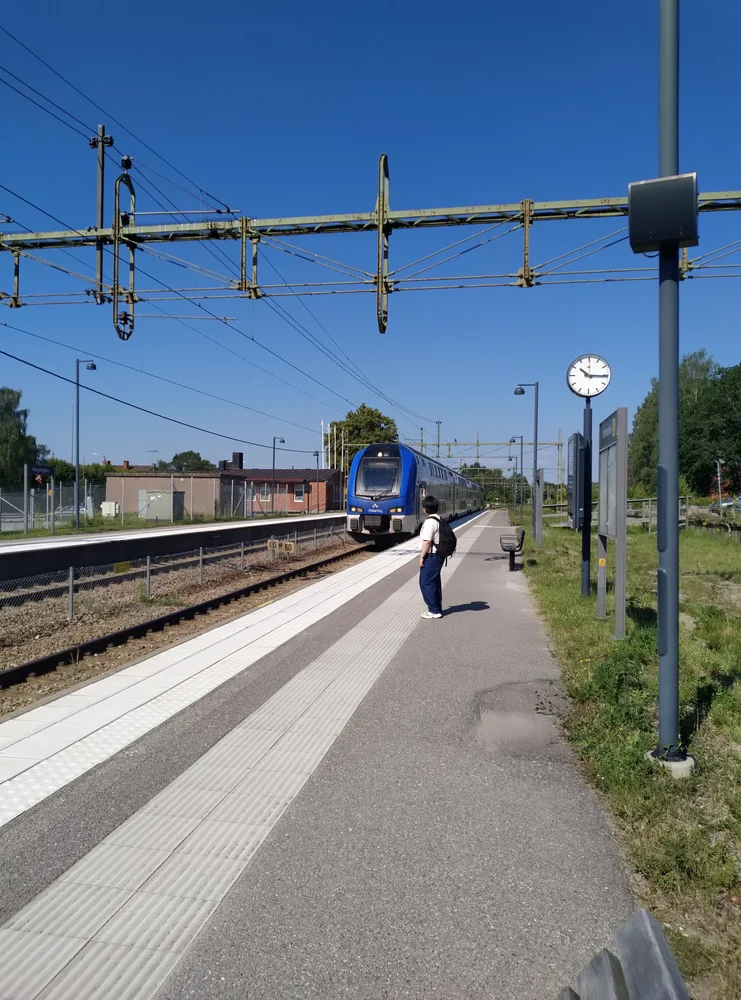
On the first Tuesday of July, you decided to go! You bought a five-day interrail pass and on Friday morning you're already rolling from San Piego (Pardubice). The tracks are laid. What more to wait for?
And it's not about any big planning like in the case of the trip by train to Spain. From Prague you can get to Sweden with just two connections, just like you went by train to Italy last September.
When that crucial connection is available, that is. And it's not.
Date of last update: August 17, 2025
Content
To Sweden by train → Pardubice - Falun 👉 go to
Pardubice - Berlin/Hamburg 👉 go to
Playing jerky train 👉 go to
Break in Hamburg 👉 go to
Hamburg - Copenhagen 👉 go to
Copenhagen - Lund 👉 go to
Lund - Falun 👉 go to
Sala - Falun 👉 go to
Train journey from Sweden to Czech Republic: Stockholm - Pardubice 👉 go to
Morgongåva - Stockholm 👉 go to
Express Stockholm - Berlin 👉 go to
Berlin - Pardubice 👉 go to
Statistics 👉 go to
Prices 👉 go to
To Sweden by train → Pardubice - Falun
Dream on. You'll get to Prague, transfer to a train to Berlin, transfer once more to the Berlin - Stockholm express, take a fifteen-hour sleeper (bed reservation costs a grand) and the next day you're in Sweden. The train stops in Copenhagen or Malmö along the way, so you can transfer and head towards Gothenburg. Or even further: all the way to Oslo, which opens up Norway for you.
Well, that's the ideal scenario. Can't be done three days before departure. The express is already full. Back to reality.
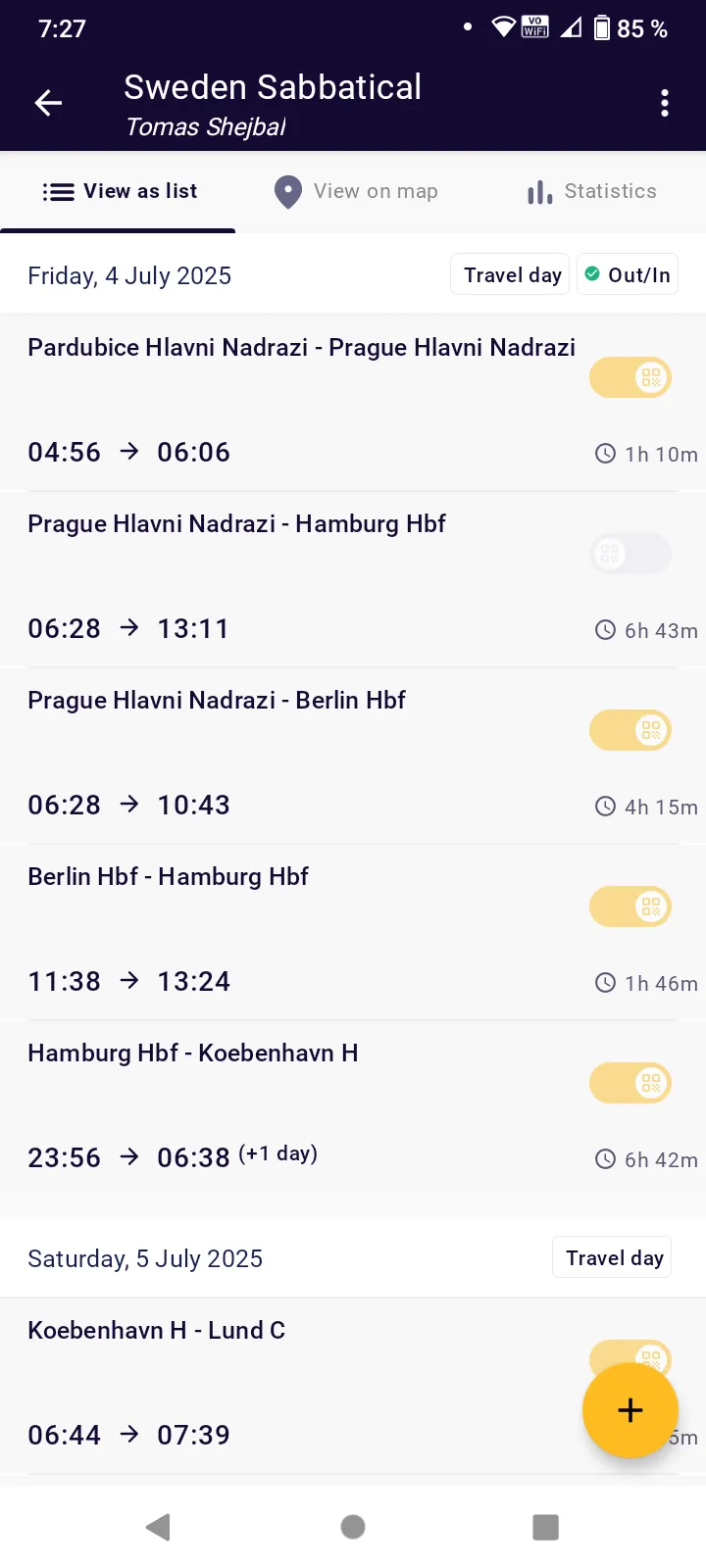
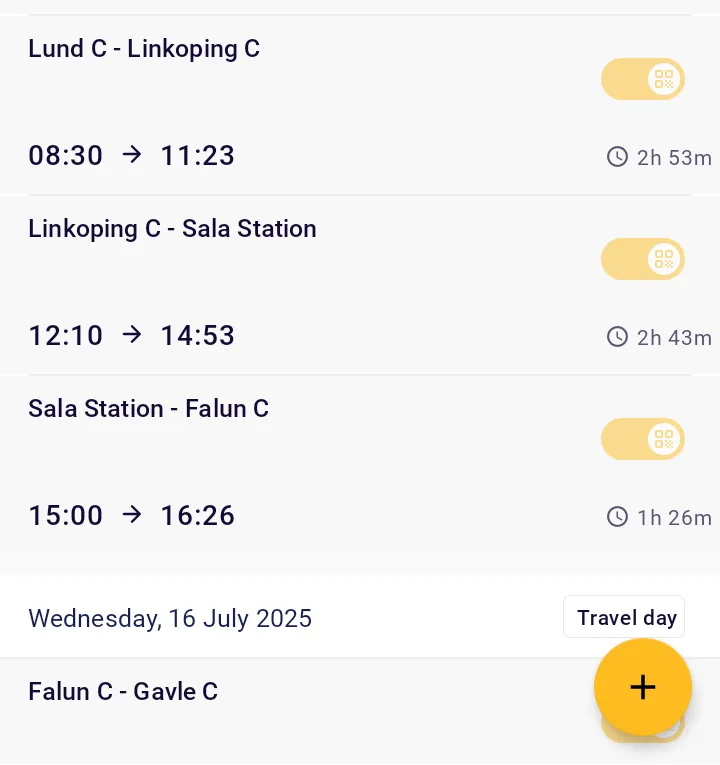
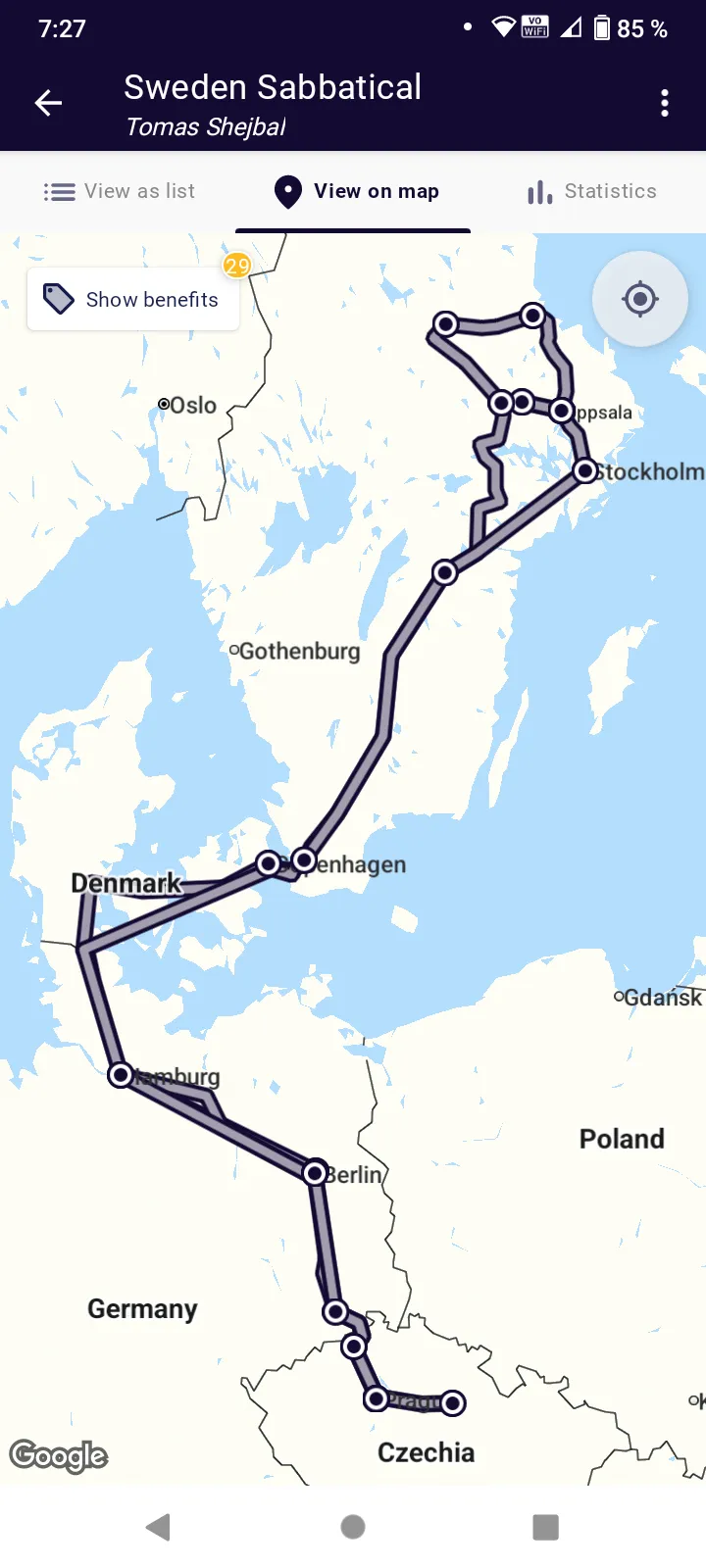
Pardubice - (unplanned) Berlin
You'll have it a bit more fun. Woow, you're looking forward to it. Very much. At half past four you're walking through sleeping Dukla, getting used to your new huaraches. Four minutes before five you're sitting on the train to Prague.
The train is over-air-conditioned. But that's fine. You have that feeling that Werich talked about when returning from Italy (where he drove by car on vacation) to Prague. He would drive through Prague, meet acquaintances and they would wave at him and say: "From the cottage?" And Werich would smile and nod his head.
You're again on the train to Prague. Routine, when you live in San Piego. Yet you're heading fifteen hundred kilometers away, somewhere above Stockholm.
You catch the Prague - Hamburg train comfortably. You have a seat reservation, so six hours of comfort await you, during which you write a new episode of Tasty Newsletter.
You stop in Berlin. The train jerks strangely.
Playing jerky train
That's how trains pull up to platforms. The one that jerks so much when starting that it doesn't even start, that's a jerky train.
And you're sitting in one jerky train right now.
An announcement sounds in German. You're in Berlin, but English? Pah. Everyone starts packing, collecting luggage and disappearing. You pack too. You disappear a bit later. After all, you got a bit scattered: you have an open laptop, charging phone, notebooks on the table, headphones, a water bottle...
Of course you connected those death throes with the ensuing rush. Moreover, you heard something in the announcement that sounds like transfer to IC. You check outside: That's right.
You go with the crowd. You get into a fast train that will cover the Berlin - Hamburg distance much faster than you would have covered it in the jerky train (assuming it would have gone). You sit on a pipe under the dining table, so you appreciate every ten minutes you save.
You're not sitting like this alone, others are sitting around you. But you still have it good, others are standing. It looks like although the jerky train didn't depart, the delay will ultimately be only an hour. Which you have time for anyway. You observe people. And nothing else.
Reports come from Czech Republic that Prague was hit by a blackout and whether it affects your journey. No, you're sitting somewhere between Berlin and Hamburg on a pipe, you reply. Immediately you add, like, on a train.
Milena also writes to you, the girl whose cat you'll be watching in Falun. Finally you have her contact on WhatsApp. The one from the pet-sitting platform is slow and you can't call if needed. You're relieved. She hadn't written all day. But you believed she would write.
Break in Hamburg
You planned your journey to have enough time for the night train to Copenhagen. It departs from Hamburg at midnight, you'll sleep on the train.
Now you have the whole day for Hamburg. You tell yourself you'll go to some coworking space and work or write. Depending on what you feel like. You have no expectations from the city.
And it immediately surprises you with how beautiful a city it is! The coworking plan falls through.
You start in a park, where you just hang out for a few hours. You read, look into tree crowns, observe locals.
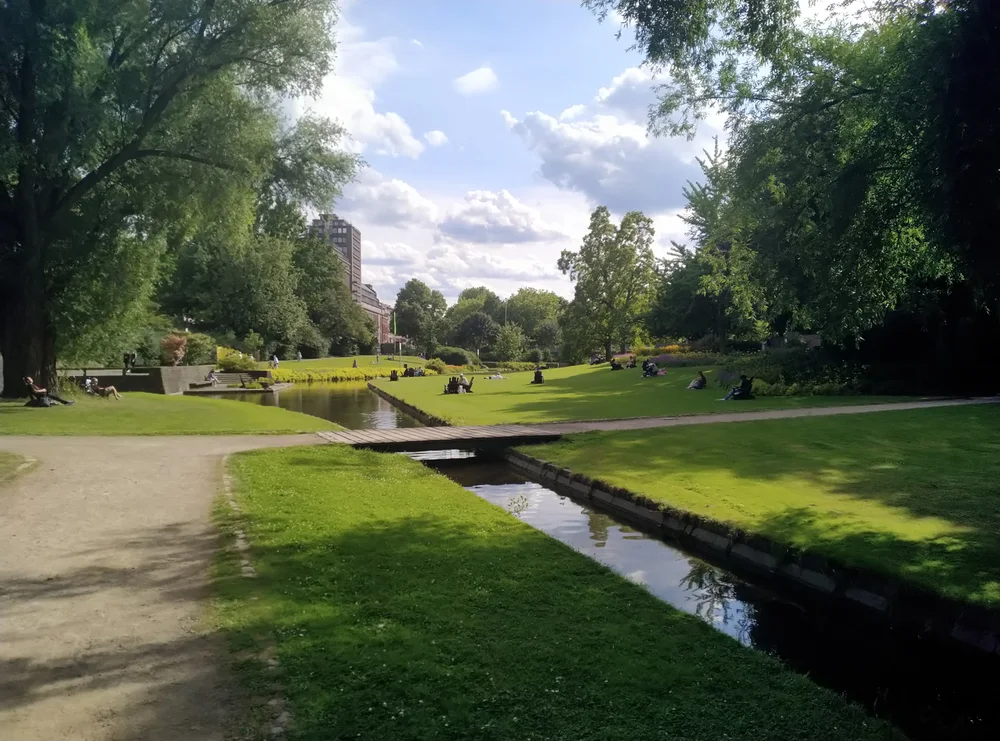
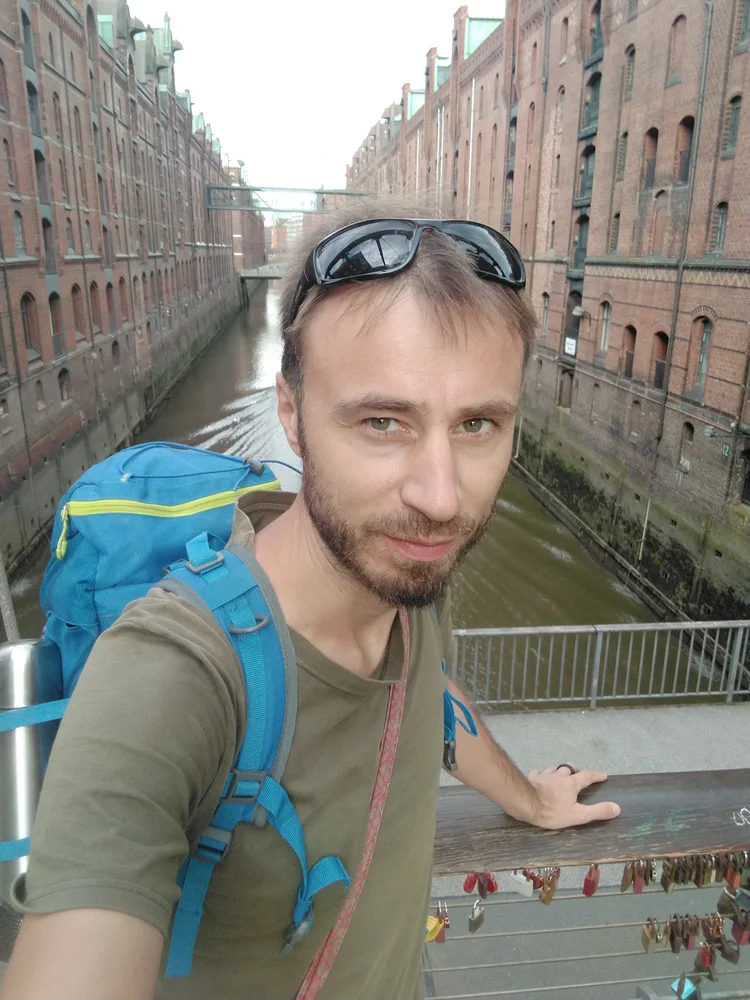
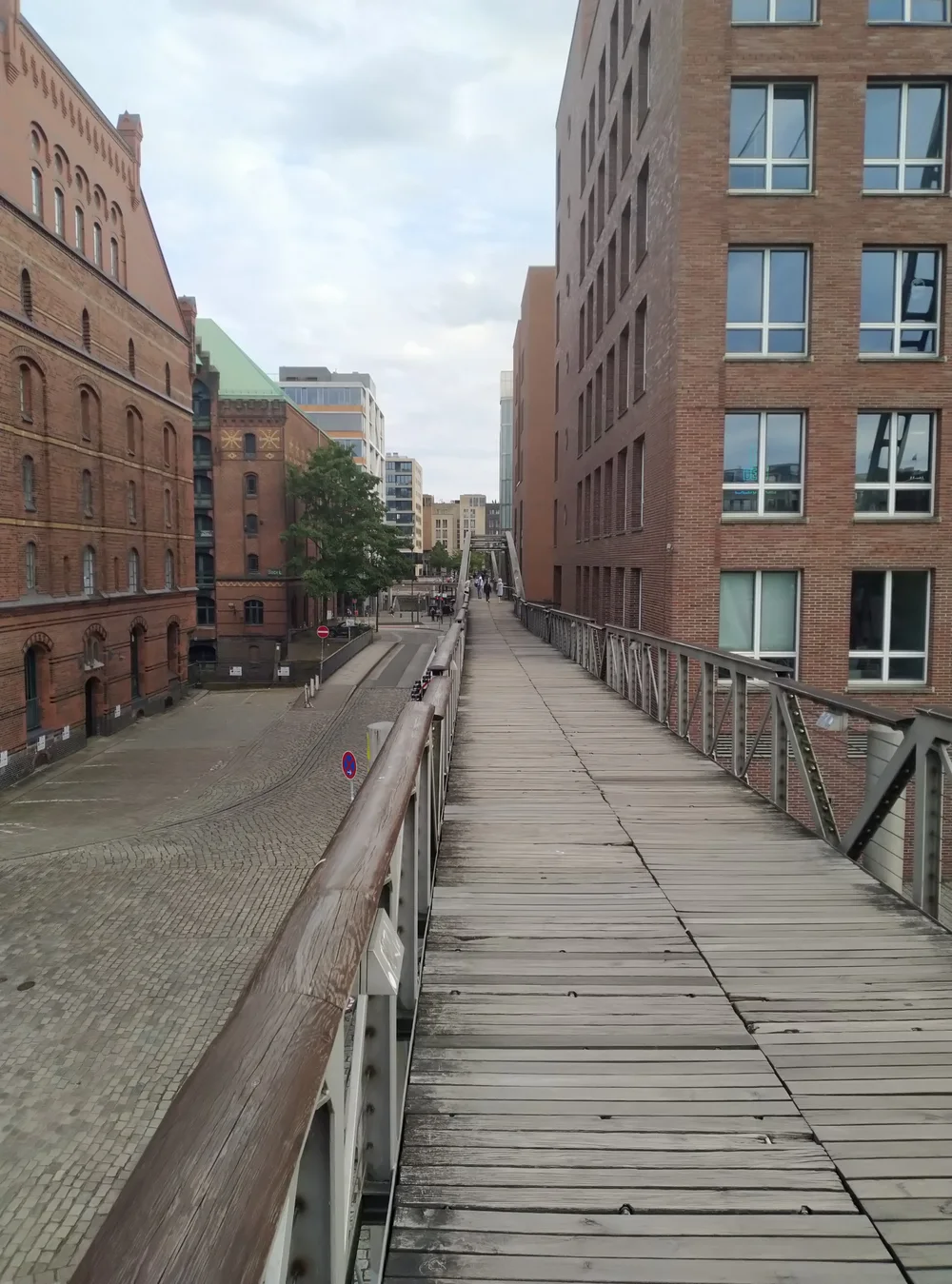
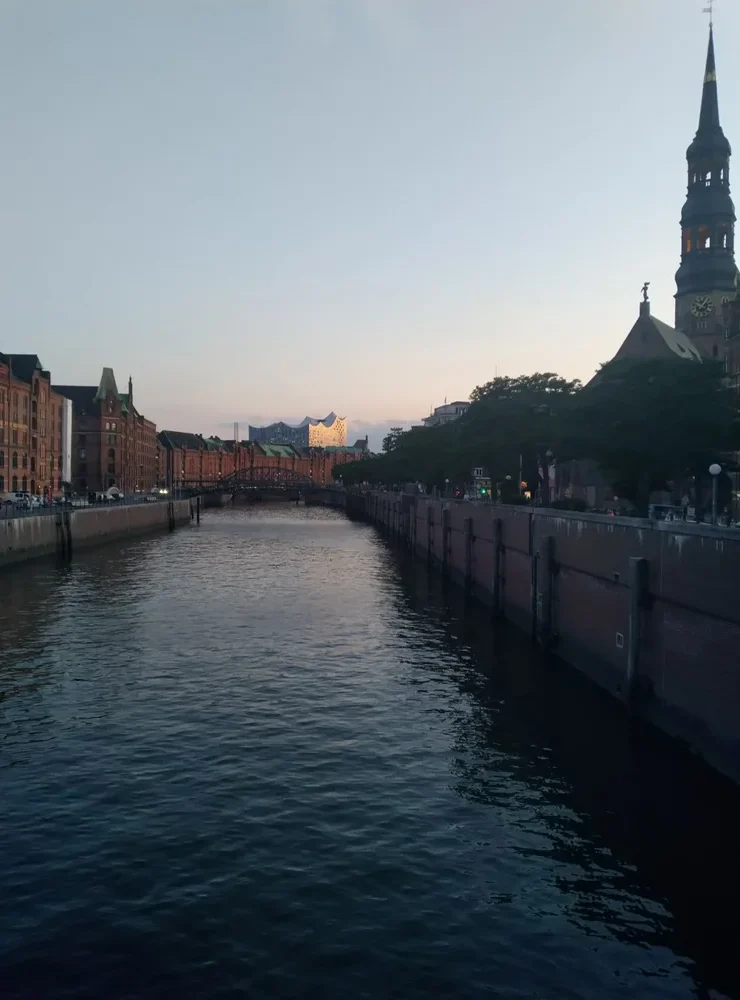
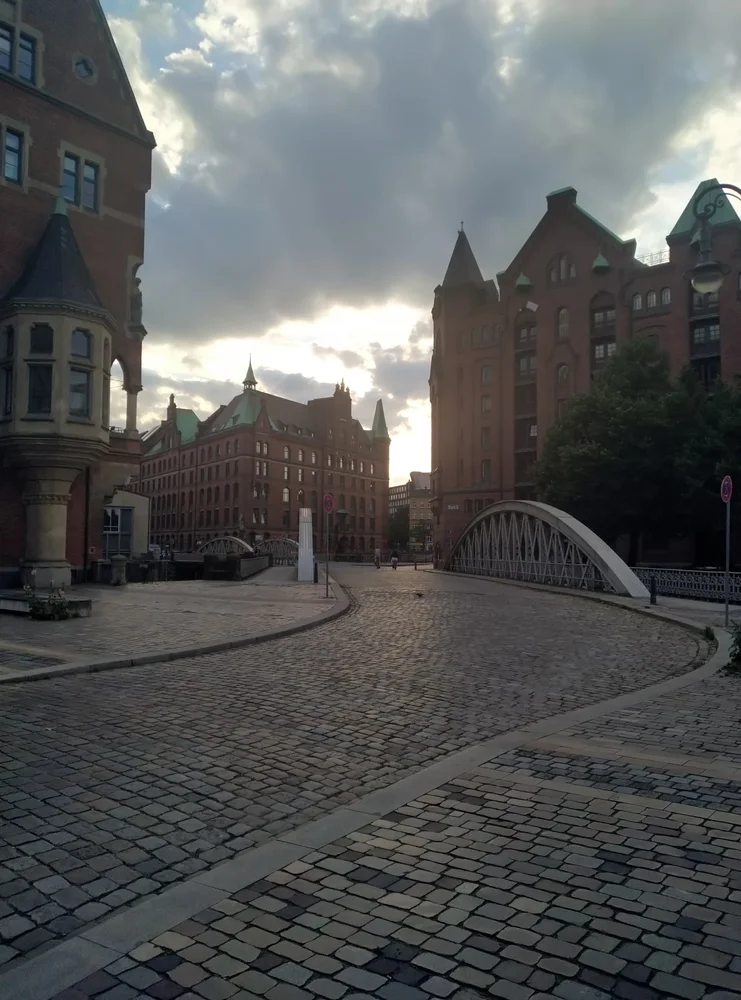
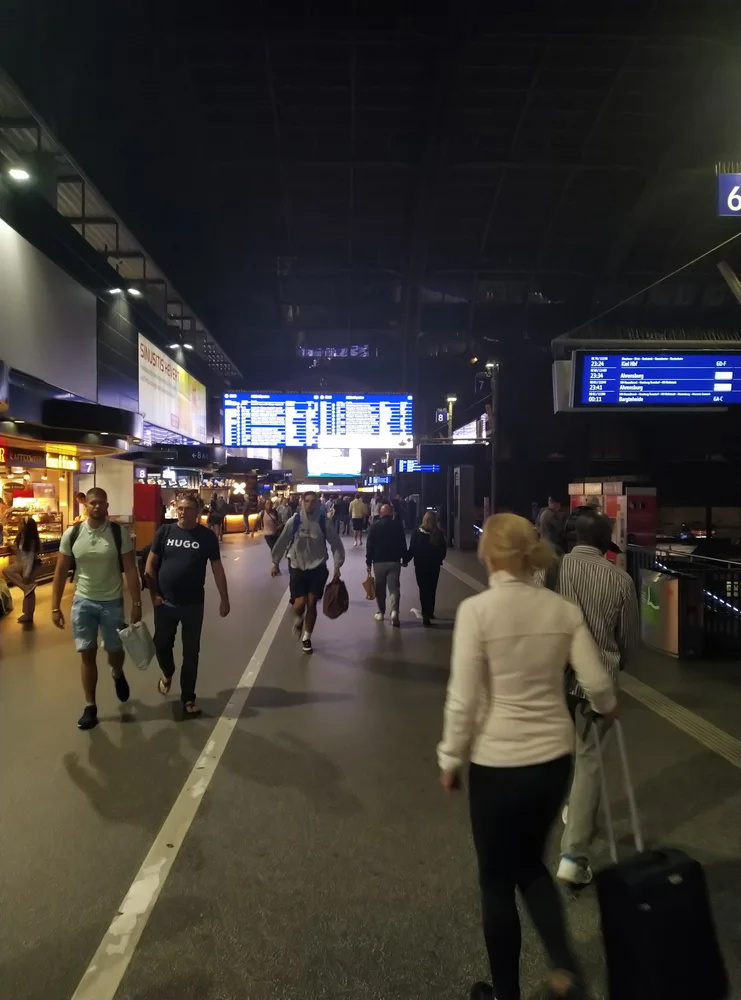
You're alone again. You have THAT feeling again. You know it from ERASMUS and both scooter trips. A mix of anticipation, excitement, uncertainty and a bit of fear. But that's probably the point, to experience that, to be a foreigner, everything is just up to you.
But you're on a journey to fulfill another of your dreams. And that's always divine. You could have chickened out, made excuses with something sufficiently believable (it's expensive; no one wanted to watch the cat for a month; it was in the city; ...) and no one would have blamed you. But you'd also be home now. You're on the road. And that's not little. Not little at all.
San Piego lies on the Elbe. So does Hamburg. The same river. And yet completely different. Rivers are important to you. And seeing "your" river in Hamburg is an incredible experience. The Elbe splits into northern and southern branches before Hamburg and creates dozens of canals in the city. You stand by the Northern Elbe and stare at that width. It gives you chills and brings tears to your eyes.
The brick buildings in Speicherstadt remind you of Automatic Mills, the wooden bridges over roads and canals remind you of the bridge you crossed as a child over the railway in Moravany. You don't know the city, yet it's like being home.
Hamburg - Copenhagen
Before eleven you return to the station. You refill water, look for the right platform, then the car. You have a seat reservation, which you quickly find. You put on a sweatshirt, settle in and wait for the train to start moving.
It's 30 minutes delayed. But you're sitting alone on a double seat. You hope it stays that way. You could spread out more.
No one comes. You lie down, legs bent and thrown to the side so they don't stick out into the aisle. You listen to music and fall asleep.
In Padborg, customs officers rush through the train, but they don't ask anyone for anything in your car. You fall asleep again. The sleeping isn't comfortable, but you don't mind. You're on the road!
You arrive in Copenhagen on time. The original thirty minutes melted away.
Copenhagen - Lund
On the train, the conductor announces that whoever is quick will catch the train to Sweden from platform six. Those who aren't rushing can take the one from platform seven. You planned to take the one from seven, but why not try your luck? A cascade of transfers awaits you, arriving somewhere a train earlier could come in handy.
So you have five minutes for the transfer. You arrive at a platform from which you just cross to the opposite parked train. You throw your backpack overhead, sit down and the train starts moving.
You're looking forward to the bridge over the sea. It only takes a moment and you're driving onto it. You remember how this place fascinated you in elementary school during geography lessons. Not just this, all of Europe. But Scandinavia... always. You never really believed you'd see it. You heard these were expensive countries. With your parents you only went to Croatia and the surrounding world seemed distant, dreamy, unreachable.
You smile at little Tomík and show him to look out the window. He has to see this. It's drizzling lightly, the sea reflects gray clouds. In the distance, like a mirage, Malmö shimmers.
When the train stops in Malmö, three of you remain in it. You don't let yourself get worried. You continue sitting. On the screen you see that the final destination is Lund.
And Lund comes. You have fifty minutes for transfer here. You go to see what's in front of the station. You repeat to yourself again how great train travel is, that stations are (usually) in city centers. But it's raining. So you immediately forget about the center. In front of the station you withdraw Swedish crowns. You look at bike stands, of which there are more than in San Piego. And you wait for the connection to Linköping.
Lund - Sala
The Lund - Linköping route shows you the first forests, meadows and especially stones that are randomly scattered around the edges. But it's not yet what you imagined.
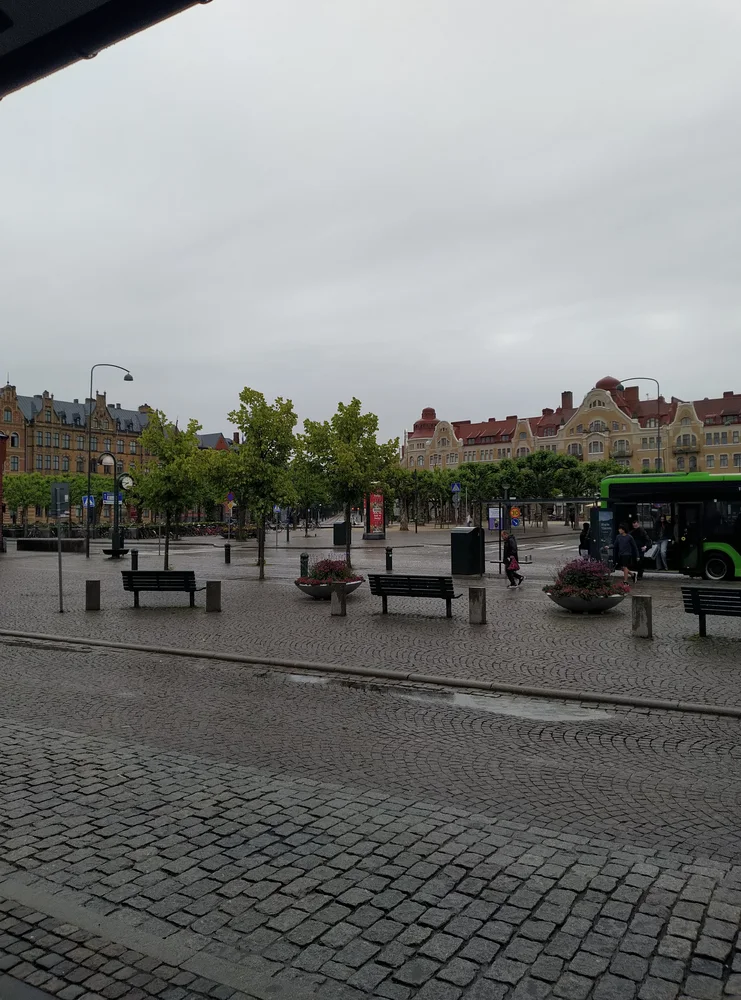
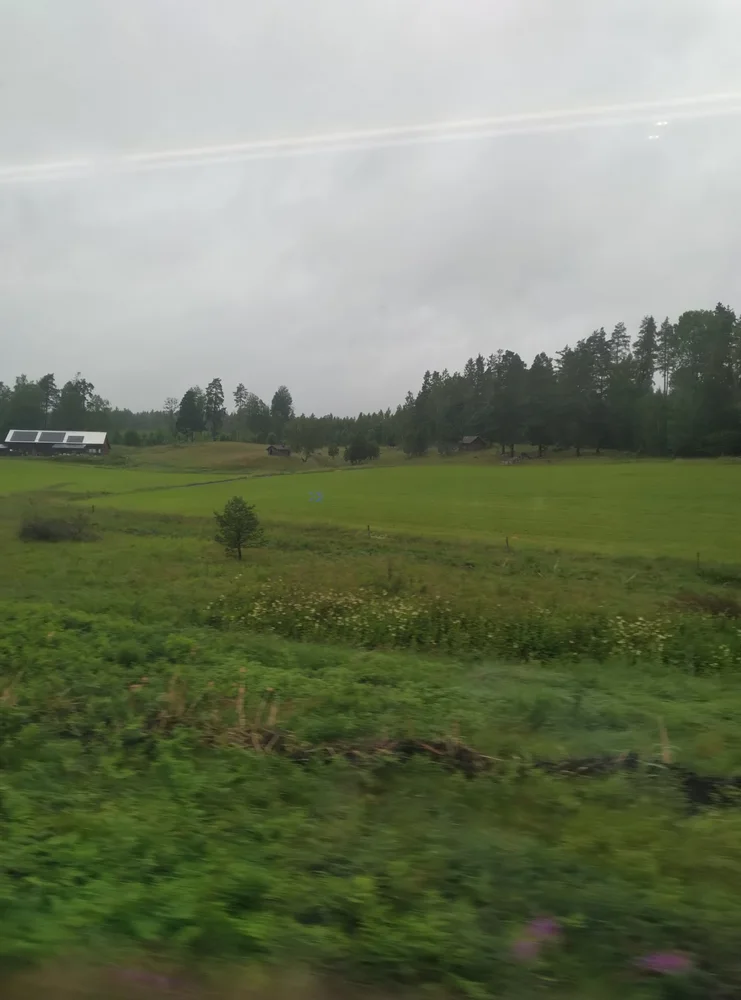

You turn on your laptop and finish writing the Tasty Newsletter, read through it one last time, set it to send the next day. You have a good feeling - you gave it enough time again, selected interesting things for subscribers that caught your attention in the last fourteen days, condensed them to the maximum and wrote a great opener about it. About fulfilling dreams. The newsletter goes to a thousand mailboxes. Sure, about a third to half open it, about ten people reply to it. Each time a bit different ones. You're happy it entertains them. You enjoy writing, they enjoy reading. You're mutually beneficial. And that's nice. A tear drops from your eyes again.
You smile again at little Tomík, who suddenly shifts in his seat and tries to be invisible. Don't worry, you tell him, no one will laugh at you now. And even if they did, you feel good and that's the only thing that matters. Back then you didn't know it was okay, just like the world back then didn't know. The nineties and people in them had other worries. It's okay to squeeze emotions out of yourself. Come on, let's go look at the world that's changing outside the train windows. And the train goes on.
In Linköping you have enough time for transfer. In another three hours you get off in Sala.
Sala - Falun
The last transfer awaits you. You have seven minutes for it. You'll make it. You've made your first observation: trains in Sweden run on time and regional trains are nicer than IC. Moreover, reservations aren't mandatory on regional trains.
You arrive in Falun. Your heart beats with excitement. Yesterday at five in the morning San Piego, now half past four in the afternoon about plus minus fifteen hundred kilometers away.
Milena and Björn are waiting for you at the station. About that in the follow-up article (coming out in 2 weeks). Now we're traveling by train.
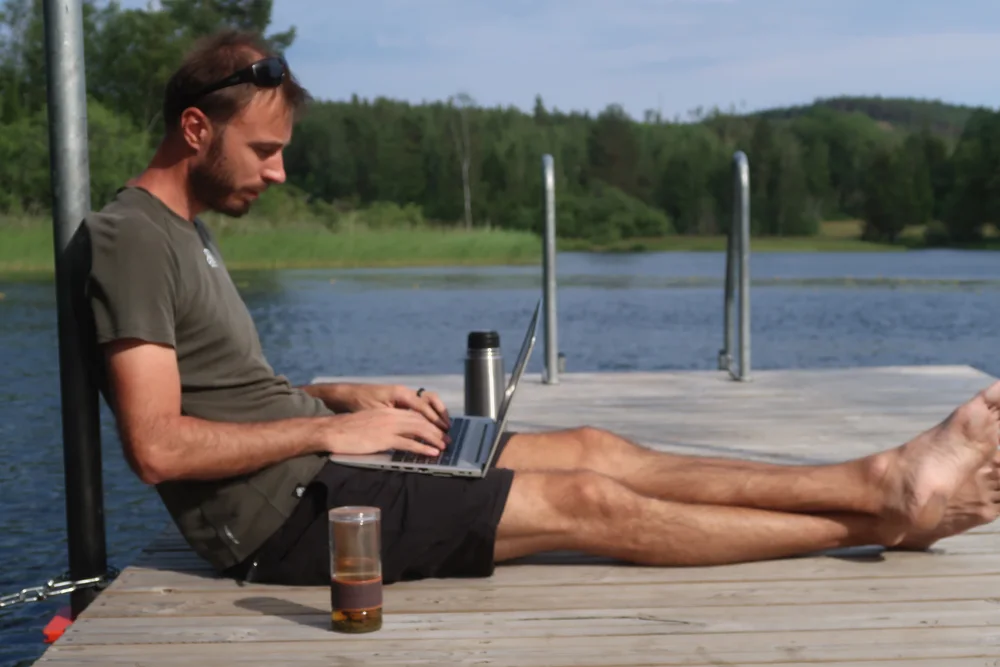
Train journey from Sweden to Czech Republic: Stockholm - Pardubice
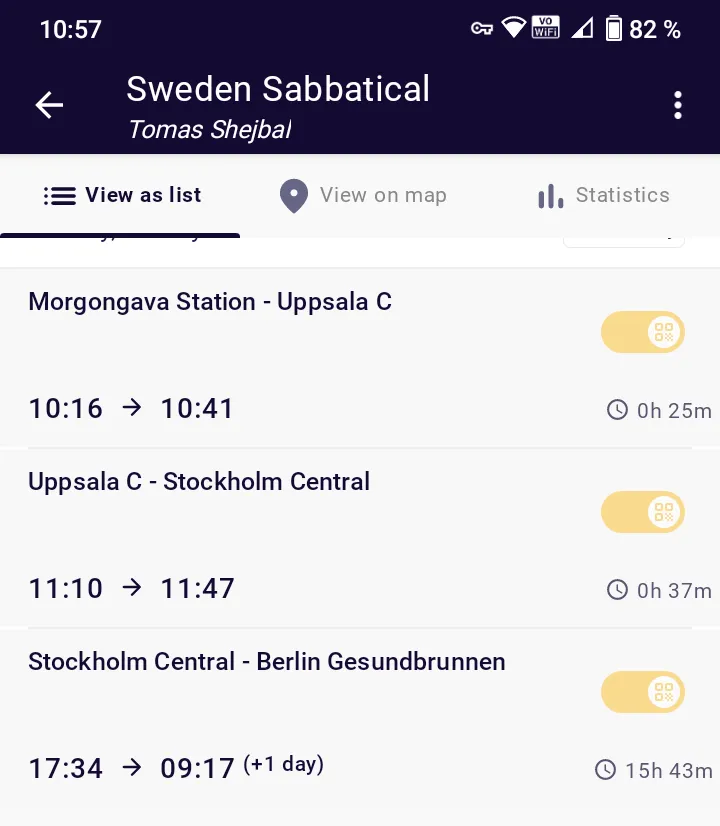
After ten days in Falun you travel by three trains to Morgongåva. You transfer in Gävle and Uppsala. You're in Morgongåva for four nights. And on Sunday, July 20th, you begin the journey back.
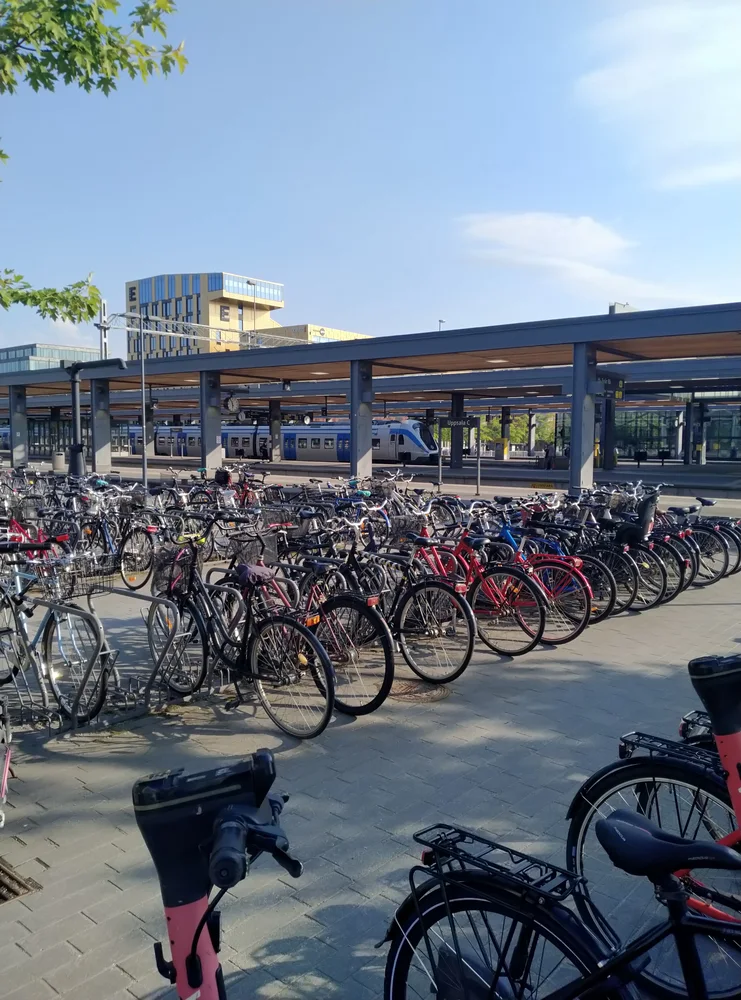
Originally you thought you could spend the whole day in Uppsala and then just move to Stockholm for the night train. When you looked at Stockholm on Google maps, you immediately threw that plan away. Stockholm is evidently a dense city, with lots of islands. It would be a shame not to walk around and hang out there. Maybe even write.
Morgongåva - Stockholm
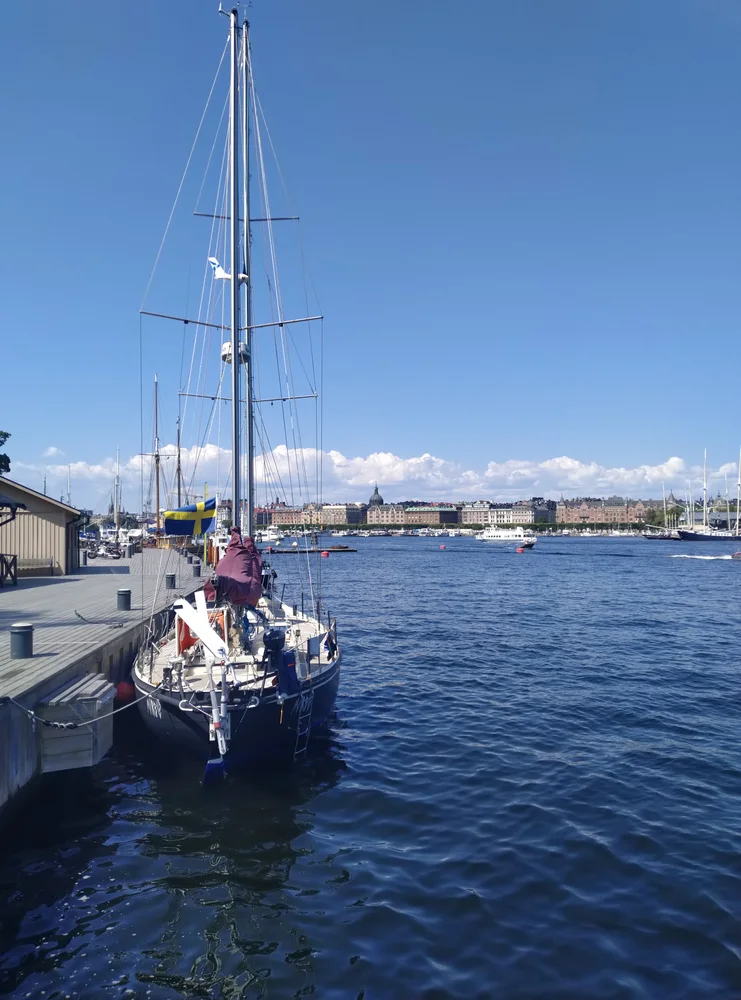
You go to Stockholm via Uppsala. You have six hours until the express departure. You walk around the islands, try to find a tea house. You find one, it's permanently closed. You reach a second one - they just closed it. There won't be tea, Tom. You'll have to endure it. You swallow the exclamation about the coffee lobby...
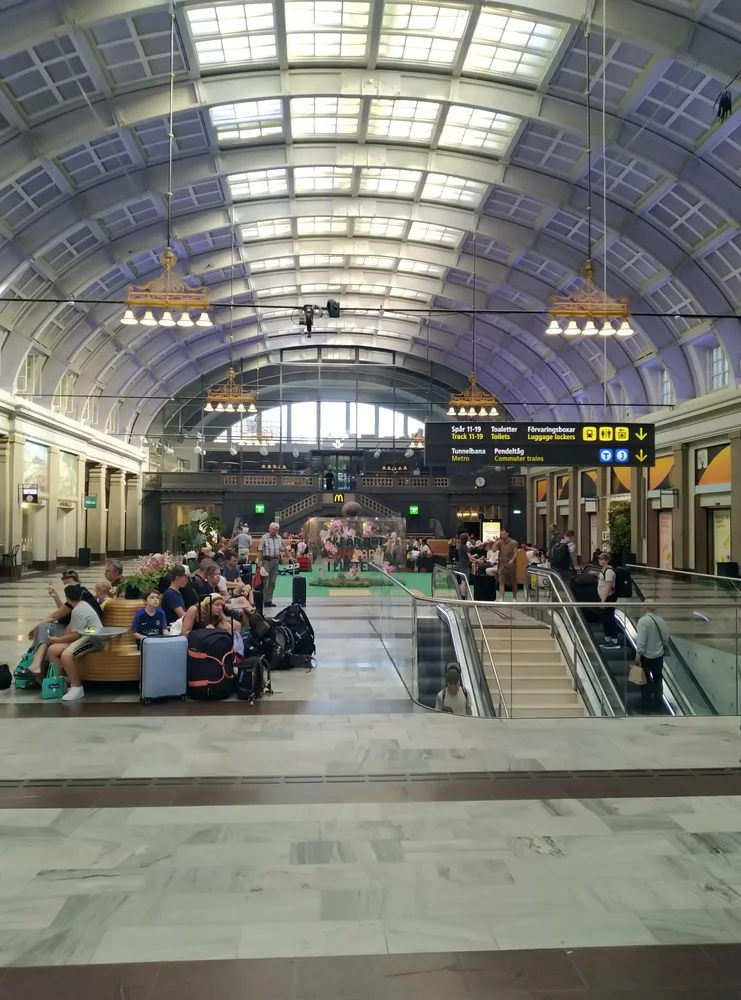
Time goes quickly, you return to the station. It's beautiful. Benches everywhere, even for lying down. Why doesn't this work in Prague?
Express Stockholm - Berlin
You board the train. It's a compartment. The beds are only on top for now. After a while you and your fellow passengers agree to make four more beds from the seats. You have a reserved seat in the middle (there are 6 places total).
There are four guys here. A Swede and two young black men who look a bit scared. The bedding challenge challenges all of you. You try for a while. The longer it takes, the more you feel like an incompetent idiot. Sure, you hate making beds. Rather than make beds, you take a sleeping bag with you. But you're not armless, are you? You notice how you all peek at each other inconspicuously. It's not working for anyone! After a while you discover that you all have double sheets.
The black guys and you finally succumb to salamism: you just throw a sheet over yourselves. It's warm. Plan B is to throw a blanket over yourselves if it gets cold at night.
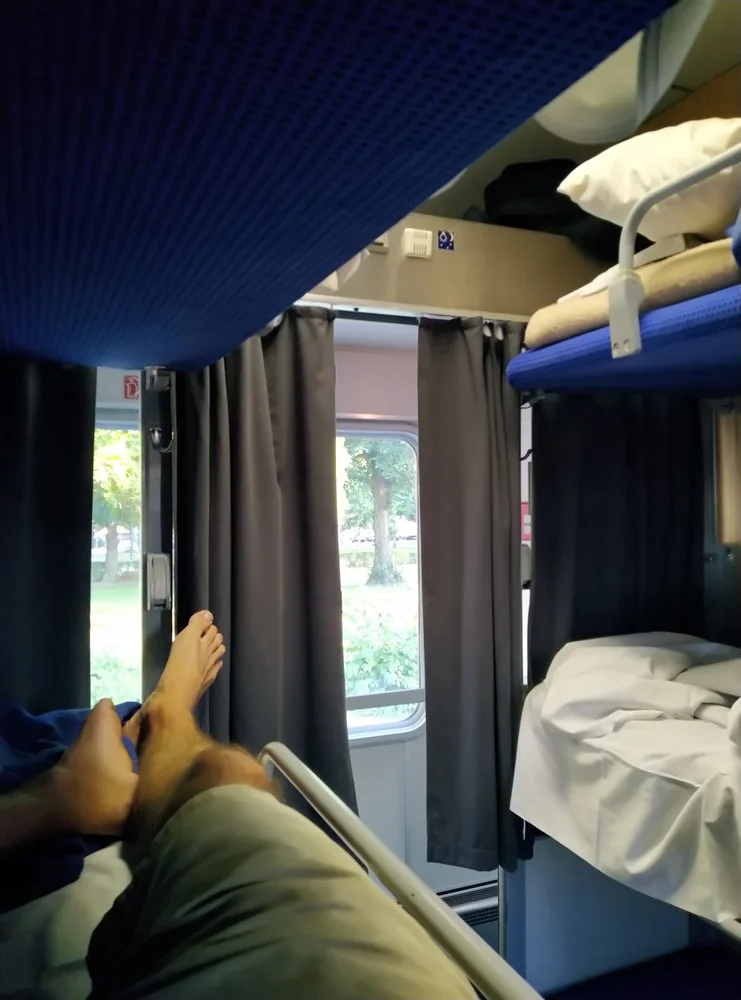
But the Swede refuses to give up. He stops the conductor. He has a smile on his face that's something like: "Well yeah, mommy or wifey makes your bed at home, right?" He starts fumbling with the bedding and looking for a hole. The smile slowly fades from his face. It's not working for him either. Finally he leaves and returns after five minutes with the right piece. Me and the black men were relieved that we're not as hopeless as we were already afraid.
The journey is so cool. You lie down, the train clatters, you listen to music, observe the landscape from the window. When your eyes start to droop, you throw the sheet over yourself.
In Malmö the light wakes you up. Two more passengers board. It's midnight. One has crutches and tape on his knee. You don't really understand why he reserved the highest bed. Maybe he doesn't either, but he eventually climbs up. In Hamburg they get off, same as the black guys.
There you fold down the beds and get to know the last guy who also boarded in Malmö. He slept downstairs. A guy who absolutely loves interrail. He travels every year. Last year he went through all of Italy like this. The Swede listens to this and then asks a question with a pitiful expression that we don't understand: Don't we have buses in Europe? Train travel seems terribly uncomfortable to me.
We shake our heads. Well, not everyone is a train person. 😄
Berlin - Pardubice
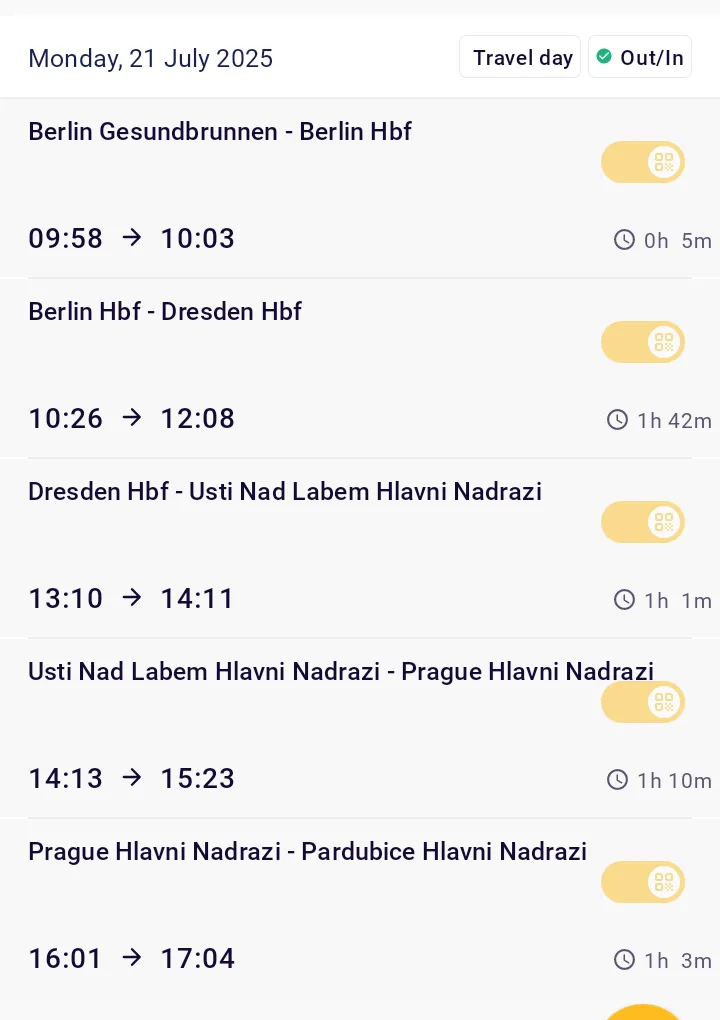
The express arrives at Berlin Gesundbrunnen station one hour late. From there a train to Hbf (main) runs about every ten minutes.
You didn't want to plan the connection from Berlin to Prague. Just because anything can happen on a fifteen-hour journey. Including the train turning into a jerky train, you know.
Now you see that the train leaving in an hour to Prague has mandatory reservations. No problem, it costs 75 CZK. But they're sold out. The next train to Prague leaves in three hours, there would be seats available. You don't want to wait. You look at options.
One of them is to postpone the decision to future Tom: you jump on the train to Dresden. On the train you figure out that the one from Berlin has one seat from Dresden to Ústí nad Labem. You take that. And then in the app you find that from Ústí to Prague you can buy another seat reservation right across the aisle. That one isn't mandatory, but the train is evidently packed, judging by the sold-out seat reservations. You buy both.
In Dresden you have tea in a café, start writing México mágico, vole and continue with it on the Dresden - Prague train.
In Prague the last transfer and at five you're in San Piego. Stockholm - Pardubice in 24 hours. Woow. You're happy as a flea. It was divine.
And it fulfilled its Sabbatical purpose. But about that next time (in those 14 days).
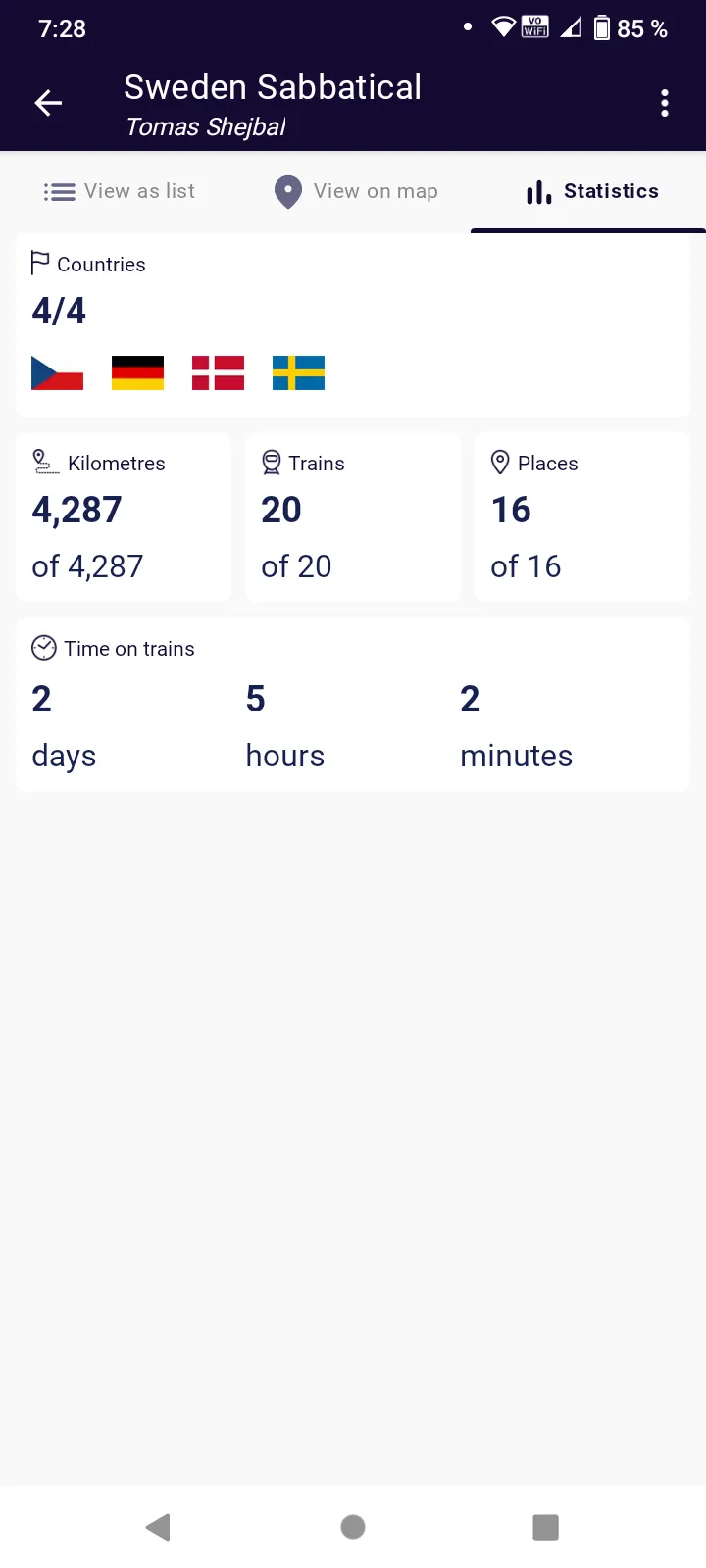
Statistics
Above you can see the screenshot from the interrail app. Interesting summary:
- 4287 km by train in 20 trains during 5 days.
- Total travel time 2 days and five hours.
Prices
Interrail cost 8000 CZK - version 5 days of travel anytime within one month. Additionally I paid these reservations:
- Pardubice - Prague: 35 CZK
- Prague - Hamburg - 75 CZK
- Hamburg - Copenhagen - 75 CZK
- two trains in Sweden on the way there: 500 CZK
- bed in Stockholm - Berlin express: between 900 - 1000 CZK
- Dresden - Ústí nad Labem: 75 CZK
- Ústí nad Labem - Prague: 35 CZK
- Prague - Pardubice: 35 CZK
Total therefore 8000 CZK + reservations 1830 CZK = 9,830 CZK.
Does train travel tempt you more to the south than north? What about by train to Spain? or by train to Italy?
Visiting 17 package-free stores on a scooter. That's worth getting wet for.
Aš to Kremenec? Well, I actually didn't make it all the way there... how come? We'll get to that. I'll also mention which 17 package-free stores I visited. Eventually we'll get to that getting wet part too.

Last update: July 15, 2023
The planned route of 1200 km stretched out a bit again. By 200 km. Of that, 760 km fell on the Czech Republic and 640 km on Slovakia. Along the way, I visited 13 package-free stores, stood in front of 4 more, visited a zero waste producer of fermented goodies, a scooter manufacturer on which I whizzed around, and met lots of interesting people. I heard lots of interesting stories too... and almost at the end I was searching for my actually non-native roots.
What one won't do to visit package-free stores
Packing
This year I started packing on time. I even mounted a carrier on the scooter and tested the placement of panniers and a waterproof bag on it. The only thing that gave me some wrinkles was reducing the luggage space volume from an 80-liter backpack to 53 liters (35 l pannier + 8 l bag + 10 liter volume of sleeping mat).
The day before departure I packed. Even more minimally than last year. It turned out that I had some space left in the sides of the panniers.
Journey to the westernmost point of the republic
On Monday I rode the scooter to the train station and started feeling how the scooter behaves with a loaded front. It demanded about two seconds earlier reaction to direction changes from me. Nevertheless, I reached the station, boarded the pendolino according to plan and sat for 4 and a half hours on the train. One transfer, another half hour on a local train and I was in Aš.
In Aš I found that I couldn't replicate the original pannier attachment from the previous day. I immediately reached for the backup solution of attaching the panniers with bungee cords and set off towards the westernmost point of the Czech Republic, so I could start with Jelen's crossing of the republic.
From reaching it, I already headed east and slept in the evening near Františkovy Lázně, where I tasted one mineral spring after another. My favorite is the Sluneční pramen (Sun Spring). 😉
You can see what the first day looked like in this video.
17 package-free stores on the route
I'm not describing the journey day by day. In this article I summarize the visited package-free stores and try to point out what caught my attention in them.
Medlenka (Cheb): the westernmost of package-free stores
First package-free store on the journey. Medlenka is more of a farm shop, package-free/packaged ratio about 1:1. According to the owner, it's a sustainable concept. Package-free only wouldn't thrive. The owner tries to "tighten customers on food", tries to set trends in Cheb. She looks for suppliers who don't supply to Cheb and thereby draws customer interest to the store.
Bezobalofka (Rokycany)
At Bezobalofka I was struck by the vermicomposter. The assortment also includes biodegradable band-aids. Otherwise it's a "classic", nice package-free store. I was struck by the relatively wide selection of cosmetics and other decorative/useful things.
During my visit, several people passed through the package-free store. Most went for Scuk, some of them also bought something from the offered assortment.
Vojta Sedláček - Bezobaly
With Vojta we had agreed from the beginning of the trip that we could meet and see each other in person. However, I didn't know what time I would be near Příbram. In the end I slept at Vojta's. We discussed everything and I hope we didn't see each other for the last time. 🙂 And thanks again for the accommodation!


YesBez (Příbram)
I like every package-free store, each is exceptional in something. But YesBez, that was really an experience. Generous bright space, together with a vegan bistro. Absolutely the highest concentration of people I've ever seen in any package-free store.
Thanks to the combination with a bistro, you can have your shopping prepared while you eat/drink a beverage of your choice. But maybe it's a shame, because Jirka is very nice to talk to.
There was an exhibition of beautiful, soul-pleasing paintings in the shop and an offer of "spirit/esoteric" items from local artists/craftsmen.
I was also struck by the aged cheeses from a nearby dairy in the assortment. They tasted really great. Especially in the evening in a hammock with legume chips.
Jirka constantly had to run behind the counter to serve customers. "It needs an owner who knows his assortment and eats the foods he sells himself," he says. I saw on people how they let him peek into their privacy and left with a smile on their faces.
Only the presence of the owner can do this, or at least a part-timer who is on site often and has passion for their work.
I continued further to Sedlčany. In Sedlčany, the trajectory of last year's "Heart Without Packaging" intersected with this year's journey.
Vlašim bez Obalu
The package-free store in Vlašim is small, but packed with assortment. It struck me as a kind of "big pantry".
Books are also sold in the package-free store. If I hadn't been on a scooter, I would have bought several immediately. The titles are arranged exactly for me: self-development, ecology, inspiration. I was also struck by board games and "meaningful toys".
Dana, the owner, also runs a library of similar focus. She shares her own library with others, for free. Meaningful conversations are also held in the package-free store space.
Mr. Salatoff
After Vlašim I went over to Blaník, which I climbed... which wasn't very tactical. Although it didn't take me much time, I still got behind schedule and was late for the meeting with the family from Mr. Salatoff. I apologize once again for the delay.
Mr. Salatoff makes fermented goodies and drinks and also vegan lunches in returnable containers. They supply to selected package-free stores and have non-growth in the company's DNA. They want to make good food, inspire (zero-waste), not burden the environment and at the same time secure a comfortable financial background through business.
We talked on a meadow under Blaník, they let me taste a few pieces and I must admit that I'll still have to work hard on my kimchi. Delicious! You can find their products in Vlašim bez Obalu, or for example in Prague at Bout.
Dobroty od Vážky (Havlíčkův Brod): first of the package-free stores I didn't catch open
At Dobroty od Vážky it didn't work out for me. I arrived on Saturday evening. However, before arriving in Havlíčkův Brod, I conquered half of Jelen's crossing of the republic on the dam of Sedlice reservoir!
Bezobalík (Žďár nad Sázavou)
Although I arrived on Sunday, Alena, the owner of Bezobalík, opened the store for me. Not just the store, but also the doors of her household. I could thus get to know her family and try the culinary skills of most family members (excellent!).

Several things caught my attention at Bezobalík:
- Storage on the first floor, although the store is on the ground floor.
- Beautiful bright space in a shopping center. There's also a butcher shop and wine shop upstairs.
- Adaptability of milk suppliers - Alena convinced them to start delivering in returnable glass.
- Alena gives the shop a social dimension - by employing socially disadvantaged people and also products from sheltered workshops.
- Handling "waste": boxes are made into other gift decorations for jars and binders for documents.
Špajz plný dobrot (Kunštát)
Inside I felt really good. Like somewhere at a cottage. It was due to the wooden floor, counter and a bit of twilight. It's about half package-free. The other half is something like health food and a village shop. The shop isn't located directly in Kunštát, but in an associated village. The shop is right by a first-class road and in the short time I spent here, several people came inside.
At Špajz plný dobrot I discovered laddu (sweet treat made from chickpea flour). I hadn't heard of it until then and I like Indian cuisine.
Bez obalu v Srdci Hané (Prostějov)
Bez obalu v Srdci Hané didn't work out. I arrived on a day when it was closed, plus craftsmen came to the owner.
Mibo
Manufacturer of Czech (best!) scooters. For 7 years I had a Mastr (the scooter from last year's trip) this year Split, so I'm not complaining!
They took care of me despite not having arranged a specific time beforehand (just the day). Martin (below in the video preview), production manager, took care of me and also showed me around the production. He also let me check out other models and even let me ride the director's road bike. Pssst!
I was amazed at how five-meter "tubes" become a scooter. By visiting Mibo I confirmed why I went with this brand seven years ago. From Mibo's website:
"We produce only 2500 scooters each year. In that number is hidden our commitment to deliver everything in the best possible quality and with very personal customer service. Production volume is not a priority for us. We don't see ourselves as a constantly growing company trying to assert itself in the market through production volume.
from MIBO website
Innovation and practicality, joy of riding, safety and community, these are our themes."
Almara (Horní Bečva): first of the package-free stores that was founded without expecting profit
I have a smile on my lips. Almara, that's a world of its own. Radan, the owner, is lively, friendly and active. At the same time, it's the first store (that I've heard of) that the owner founded with the idea that it wouldn't generate profit.

The shop is run by the association Duša ZEmě, z.s., a non-profit organization fully identifying with the principles of social entrepreneurship. The package-free store is thus just one of many activities.
Horní Bečva is a village in the Beskydy Mountains, where lots of tourists head in summer. The package-free shop is in a pleasant location, has several tables for drinking coffee and eating some goodies, or local ice cream.
Kredenc bez obalu (Frenštát pod Radhoštěm)
Kredenc bez obalu is, along with the Ostrava package-free store (after Prague's Bezobal of course), among the first package-free stores in the Czech Republic.
The shop is small, but has everything needed. And it's very cozy. In one part there's a couch with a table where you can consume purchased goodies (verified!).
If you're going to the Beskydy Mountains in summer, stop by Kredenc bez obalu!

Beskydy bez obalu (Frýdlant nad Ostravicí)
Another smile on my face. Beskydy bez obalu you can't miss! They nicely clad the shop in wood, wood dominates inside too. The windows are large, the space is bathed in light. Besides the classic package-free assortment, there's a wide selection of cosmetics (and drugstore goods in general).
But I was attracted by the refrigerator with yogurts, cheeses and other local goodies, which I consumed right on the spot.
After Jitka, the owner, left, I had a long chat with the helper... I forgot the name. Which I regret. It was one of those conversations where both sides feel that the other is on a similar wavelength... careful probing and gradually removing the shell... deep topics... well okay, but I can't talk my way out of that name. However, the recommended novel "Adresa Naděje" I just finished. 😉 Not much happens plot-wise, yet one devours every page and can't wait to see what happens next.
Stop by this package-free store too! In Frýdlant (around 10 thousand heads) there are two package-free stores in one city. The stores are just a bit away from each other, plus interspersed with a health food store. Not much good for prosperity...
Spolu bez obalu (Frýdlant nad Ostravicí)
The space of Spolu bez obalu is airy, modern. Besides the classic assortment they also have ice cream!
Třinec bez obalu (big surprise: Třinec)
Třinec, that's not just ironworks (although they take up half the city), but also the store Třinec bez obalu. Besides the classic package-free assortment, sourdough bread is sold here. I bought one and accidentally stole one from another customer. When the customer started looking for it, I realized I had put bread in my pannier twice. 😀
I was also struck by Mňamis cookies, also perhaps the largest selection of spices I've seen in package-free stores. And I can't not mention the moss pictures!
The refrigerator also looked promising, but given my arrival on Friday afternoon, it didn't hide much anymore.
First package-free store in Slovakia: Do batôžka (Dolný Kubín)
I passed through Dolný Kubín on Saturday evening, so I didn't catch the opening. At the same time, since I expected a similar arrival time, I didn't push hard regarding "some" proactive communication... so at least from the outside. Inside it looked good!
The package-free store is located in front of something that resembles a bus station (or rather a more frequent stop), so the place will probably be busy.

Hrnček Var (Liptovský Mikuláš)
The first package-free store I visited in Slovakia. The location of package-free store Hrnček Var is right in the center in the pedestrian zone, the store is nicely visible from the street. The assortment is no exotic thing, lots of stuff is from our country.
The space is generous, the assortment extensive and includes many goodies. They say they're also quite popular. Which was immediately confirmed by a young lady who came to ask if the Marshmallows had arrived yet.
In the fridge I discovered "apricot" non-yogurt. It tasted good. Since I ran out of toothpaste (respectively the tablets got soggy in paper packaging), I got loose paste made only from herbs here. I hadn't seen such a thing anywhere before. There was a choice between "sweet" and salty variants.
One could talk at Hrnček Var for a long time and it's true that I got quite "stuck" here.
Košická špajza (Košice)
The shop Košická špajza is located perhaps two streets from the main train station. The space is tiny, but packed with assortment. The owner had shelves custom-made where jars are placed at an angle. The shelf levels can thus be very dense above each other and therefore a lot fits in the space.
Špajz Humenné (who would have thought - Humenné): the easternmost package-free store
I arrived in Humenné on Saturday about an hour and a half after closing time. Even so, it was a scooter performance. I originally thought I would pass through Humenné much later. I wasn't even looking for the package-free store Špajz Humenné. I wanted to get as close to Nová Sedlica as possible. Yet the package-free store found me - I happened to ride by and thus said goodbye to the last package-free store on the route.
And that day I managed 105 km. For the fact that it was blowing hard against me in the morning and occasionally hills rose against me, a decent performance, right?
Aš to Kremenec. All the way to getting wet?
On Sunday I reached Nová Sedlica. From Nová Sedlica I walked to Kremenec on foot. The path to Kremenec leads through an ancient beech primeval forest, it really wouldn't work on a scooter there. The wide path gradually disappears, until a narrow trail begins, trees across the path, roots...


And that getting wet? When a Slovak says: "Go to Liptovský Ján, you can get wet there." He doesn't understand it the same way we do. He's saying something like: "Go to Liptovský Ján, you can have a blast there."
And there were plenty of those wettings/swims along the way. I didn't scorn natural swimming pools, rivers, mountain streams, cold mineral springs and occasional showers when I slept at someone's place.
Summer is here. So I wish you in Slovak: "lots of summer wettings"!
Czechia to Italy by train
Imagine you want to go to Italy in two months, on Friday July 12th, around five o'clock from Pardubice (from Prague a bit earlier and from Brno a bit LATER).
The prices mentioned in the article are therefore an example of summer prices when planning two months in advance.
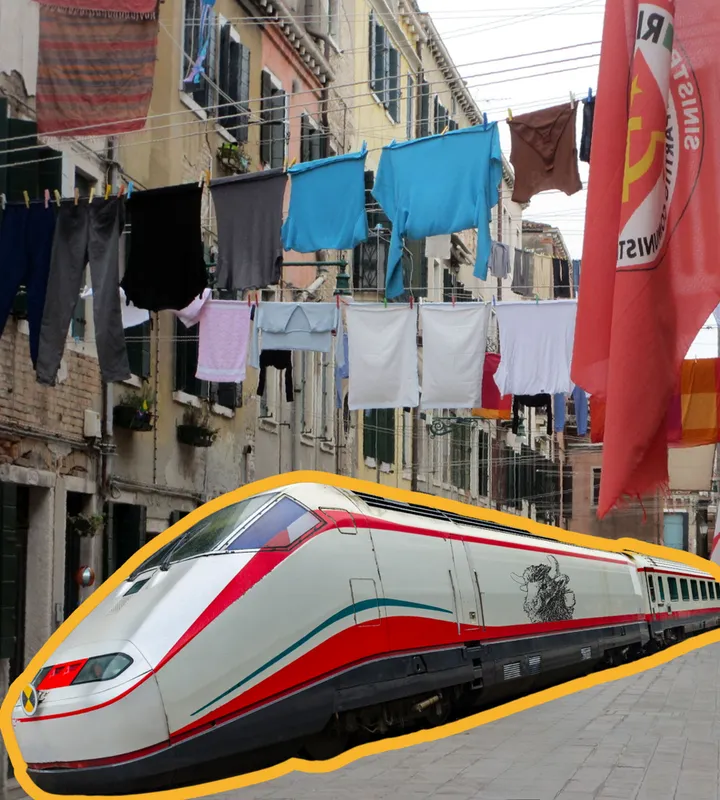
Last updated: May 17, 2024
Note 1: This article is not for quick seekers of the cheapest flights, but for lovers of slow travel, ideally on rails. What motivates someone to travel by train I already wrote about in the article By Train to Spain.
Note 2: Similarly, if you prefer bus transport, consider buses from RegioJet and read no further. To Italy they go:
- from Prague (at 23:00) to: Como and Milan (from 1999 CZK).
- from Brno (at 21:30) to cities: Udine, Venice, Padua, Bologna, Florence and Rome (from 1999 CZK).
Czechia to Italy by train
For planning, it's advisable not to use idos (occasionally surprises with wrong train arrival dates, which then allows creating connections that don't actually connect), but the search engine of German railways, or Austrian railways. Austrian connections can then be purchased (both tickets and seat reservations) on their e-shop.
Interrail
Global Pass valid across Europe
I pulled the information from the official pages about the Global Pass. Here are some Interrail variants:
- 283 EUR (about 7000 CZK) allowing 4 days of travel on any days within one month.
- 318 EUR (about 7900 CZK) allowing 5 days of travel on any days within one month.
- 381 EUR (9500 CZK) allowing 7 days of travel on any days within one month.
Country Pass valid only in Italy
I again pulled the information from Interrail pages. Here are some variants limited only to Italian territory:
- 165 EUR (about 4000 CZK) allowing 3 days of travel on any days within one month.
- 223 EUR (5500 CZK) allowing 5 days of travel on any days within one month.
- 292 EUR (about 7200 CZK) allowing 8 days of travel on any days within one month.
Is Interrail worth it when traveling by train to Italy? Let's have a look.
How to get from Czechia to Italy by train?
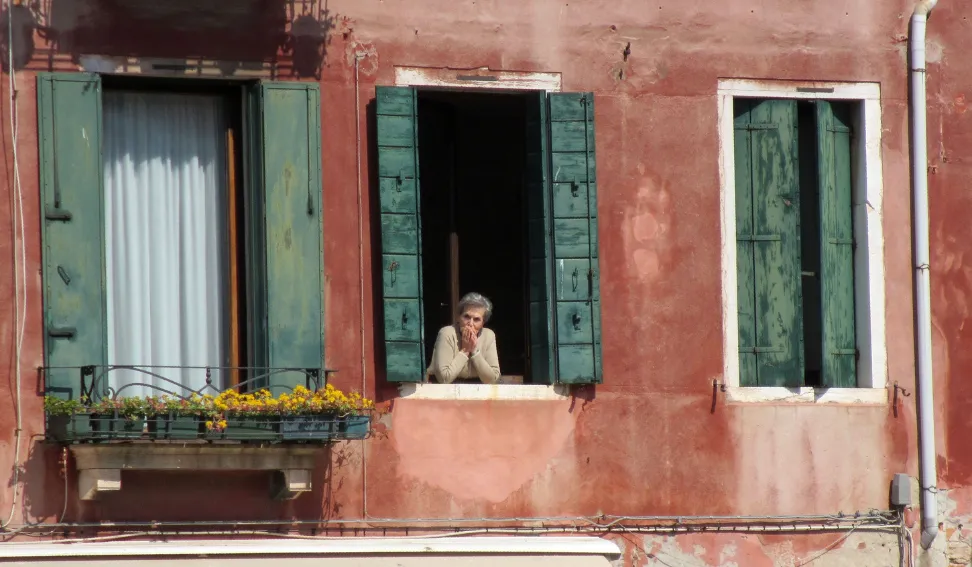
Venice by train from Pardubice
You can find a connection to Venice (the Vienna-Venice connection only runs in July), but for some reason it can't be purchased (yet?).
Note: As a taste of Venice, you can use Honza's article from birdies (primarily focused on traveling with children, but many tips are naturally of general character).
| from | departure time | to | arrival time | price [CZK] |
|---|---|---|---|---|
| Pardubice | 17:41 | Vienna Hbf | 20:49 | 329 |
| Vienna Hbf | 21:39 | Venezia Santa Lucia | 11:03 | connection could not be reserved at the time of writing |
The price for the Pardubice - Vienna connection is lower than usual (I think around 700 CZK). Probably due to early purchase.
By train to Milan from Pardubice
Let's go for the sure thing then. The Pardubice-Vienna route is the same, but then we head west to Zurich. I've already taken this connection, but in the opposite direction, when we were returning from Spain to Pardubice by train. Turn off data in Switzerland (roaming isn't cancelled there).
We'll just fly through Switzerland while observing picturesque scenery, and for lunch you can already bite into cotoletta alla milanese (Italian schnitzel, if you're not too tired from the train 😀) in Milan.
| from | departure time | to | arrival time | price [CZK] | seat reservation (for Interrail) [EUR] |
|---|---|---|---|---|---|
| Pardubice | 17:41 | Vienna Hbf | 20:49 | 329 | included when buying through CD app |
| Vienna Hbf | 23:28 | Zürich HB | 8:20 | 49 EUR (about 1200 CZK) | 16 EUR (about 400 CZK) |
| Zürich HB | 8:33 or 9:33 | Milano (Milan) | 11:50 || 12:50 | 83 EUR | 13 EUR (320 CZK) |
The price for the journey is approximately 140 EUR (3500 CZK). If the return trip costs the same money, then we're "in it" for 7000 CZK, which works out cheaper than a 4-day Interrail (7000 CZK + seat reservations: 2*720 = 8440 CZK).
So is there a variant where Interrail purchased without discount pays off for traveling by train to Italy?
Hey, those are curious questions. To answer, let's look at connections and prices for train travel around Italy. Besides that, you'll at least learn how to move around Italy by train.
By train around Italy
Arriving in Milan opens up the entire Italian railway network for us. Including high-speed trains, which you can boldly use. After all, from Milan to Reggio Calabria (all the way down opposite Sicily) it's around 1300 km by car.
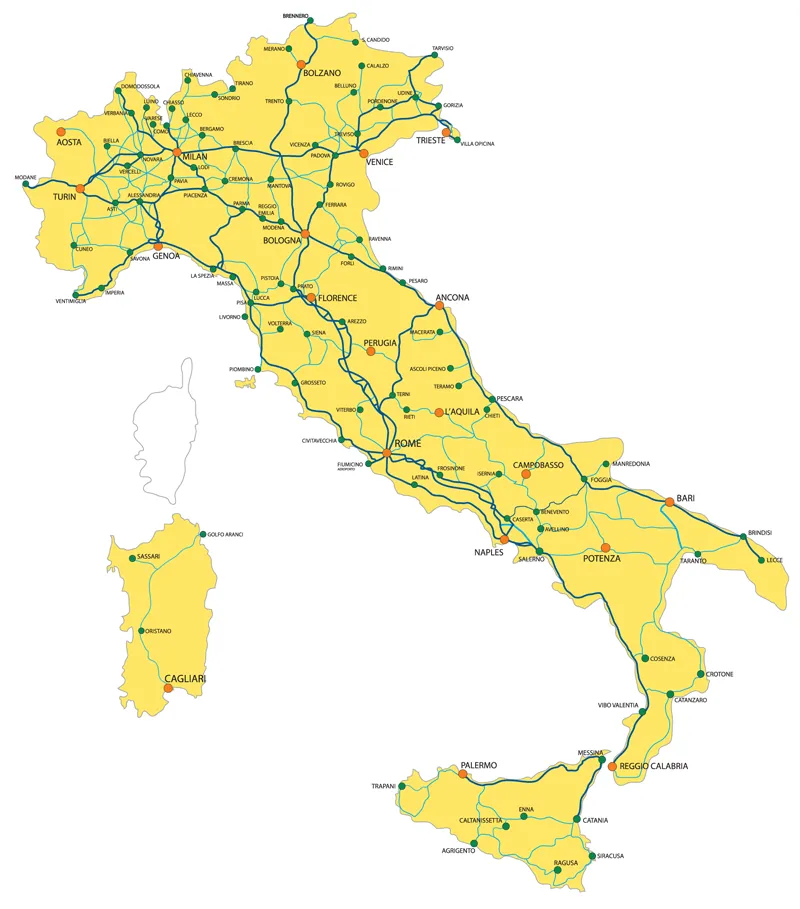
Blue lines are high-speed trains that rush through Italy at speeds up to 250 km/h. Dark green are regular intercity trains and light green are regional trains.
To get an overview of the Italian railway network, you can study the following image, which is from the pages of italiarail.com. For planning connections, use the trenitalia website directly, where tickets can also be purchased.
Shorter and medium-length transfers by train around Italy
I'm only listing 2-3 connections, but more always run. Just for an idea of times and prices.
Train Milan - Florence
| from | departure time | to | arrival time | price [EUR] | seat reservation (for Interrail) [EUR] |
|---|---|---|---|---|---|
| Milano (Milan) | 14:10 | Firenze (Florence) | 16:04 | 43.9 | 15 |
| Milano (Milan) | 17:10 | Firenze (Florence) | 19:04 | 36.9 | 15 |
| Milano (Milan) | 20:10 | Firenze (Florence) | 22:04 | 39.9 | 15 |
Train Milan - Rome
| from | departure time | to | arrival time | price [EUR] | seat reservation (for Interrail) [EUR] |
|---|---|---|---|---|---|
| Milano (Milan) | 14:30 | Roma Termini (Rome) | 17:40 | 67.9 | 15 |
| Milano (Milan) | 15:00 | Roma Termini (Rome) | 18:10 | 44.9 | 15 |
| Milano (Milan) | 20:10 | Roma Termini (Rome) | 23:49 | 57.9 | 15 |
If you were saving up to see Pompeii by train before pilots from stupid orders (part of the song lyrics "Obelisk" by Myšík), then this table will interest you:
| from | departure time | to | arrival time | price [EUR] | seat reservation (for Interrail) [EUR] |
|---|---|---|---|---|---|
| Milano (Milan) | 14:10 | Napoli (Naples) | 17:49 | 71.9 | 15 |
| Milano (Milan) | 17:10 | Napoli (Naples) | 20:50 | 62.9 | 15 |
| Milano (Milan) | 20:10 | Napoli (Naples) | 23:49 | 57.9 | 10 |
Long transfers by train around Italy
Train Milan - Bari
Anyone who read The Story of a Well-Ordered Family wants to go to Bari, that's clear. So let's see if you can find the Subverter moored in the port.
On this journey you can use night trains for the first time (from the connections listed for train travel around Italy). You'll save on accommodation and be at your destination in the morning.
| from | departure time | to | arrival time | price [EUR] | seat reservation (for Interrail) [EUR] |
|---|---|---|---|---|---|
| Milano (Milan) | 14:35 | Bari | 21:30 | 85.9 | 15 |
| Milano (Milan) | 21:15 | Bari | 7:00 | 69 | 15 |
To mafia territory - Reggio Calabria & ferry to Messina
If you're in a hurry, you can take the second afternoon one and find accommodation (or catch the last ferry in Messina). A cheaper, and probably more sensible solution is to put your luggage in storage at Milan station and set off to Reggio Calabria only on the night high-speed train.
| from | departure time | to | arrival time | price [EUR] | seat reservation (for Interrail) [EUR] |
|---|---|---|---|---|---|
| Milano (Milan) | 14:30 | Reggio Calabria | 23:09 | 62.9 | 15 |
| Milano (Milan) | 16:10 | Reggio Calabria | 21:13 | 73.9 | doesn't show in the app, maybe sold out |
| Milano (Milan) | 21:20 | Reggio Calabria | 8:11 | 108.9 | 15 |
After arriving in Reggio Calabria, hop on a ferry and in 30 minutes you'll be in Messina on Sicily (price up to 4 EUR).
Is Interrail worth it for train travel to Italy?
If you don't catch any discount, probably not.
But it depends on how you approach the trip. If you want to move from Milan the same day to, say, Florence/Rome, then we're at 7000 CZK for tickets + 2*900 = 8800 CZK. The cheapest European Interrail is 7000 CZK + seat reservations. Here it will be even.
If you go all the way south, you won't make it in 4 days and will have to choose a 5-day Interrail.
On the other hand, I dare to guess that ticket prices will rather rise as summer approaches. With Interrail you fix the prices. But it can also happen that trains will be fully booked and you won't be able to buy a seat reservation.
With Interrail you also get more peace of mind - if some connection escapes you, you only lose the cost of seat reservations for the following ones, not entire tickets.
We all have differently mixed needs. Someone wants certainty, while too much certainty suffocates others. So plan in accordance with yourself.
Alright then. Now "just" to put the plan into practice. 🤪 Ciao!
Is package-free shopping more expensive? End of speculation!
Finally, the answer to the question of whether package-free shopping is more expensive than regular stores comes. In this article, we'll look at the topic in more detail. In my previous post, I clarified, and in the video showed, how package-free shopping works. Now I'll answer the second most frequently asked question: "Is package-free shopping more expensive?"
The topic of package-free store prices was touched upon in autumn last year by Wastmanka on her blog, where she compared the price of one package-free store against Rohlík and Košík. I contacted her to see if she would like to help with the continuation, and instead I got her "blessing" to continue with the topic.

Last update: April 26, 2022
Without beating around the bush, is package-free shopping more expensive?
The conducted survey is a fairly comprehensive answer to the question of whether package-free shopping is more expensive. However, if someone forced me to answer the question "Is shopping in a package-free store more expensive?" with a binary answer (yes/no), based on the conducted survey I would answer: "No, it's not."
If numbers bore you, then maybe skip straight to the conclusion. If you're not satisfied with just a black-and-white answer (as I hope), or a few sentences in the conclusion, then continue reading 😉
Before the actual comparison
The post is structured as follows: introduction to the issue, description of evaluation, comments on graphical results and final summary.
Selection of foods for comparison
For comparison, I selected 74 foods from the following categories: flours; grains and pasta; rice and legumes; seeds; nuts; dried fruit; spices; and others.
Prices of dairy and meat products and baked goods are not compared. The reason is simple: for these foods, no overlap can be found between package-free stores, let alone regular stores. Most package-free stores take these foods from local farms, so I would be comparing prices of individual farms rather than prices of package-free stores.
Contacted package-free stores
From the map of package-free stores, I collected emails and asked if they would participate in the price survey. I sent 130 emails (not only to package-free stores, but also to stores with a package-free section). There were 116 functional addresses and 17 of them finally filled out the price form. Of these 17 stores, 14 are purely package-free. The remaining 3 stores are health food stores with a package-free section. They don't deviate from the price survey, so they are kept in it.

Although package-free stores are all over the Czech Republic (see map), it's interesting that no package-free stores from western and southern Bohemia participated in the survey.
The following stores finally filled out the forms for me (thank you! 🙏❤️):
Nosácek (edit September 2023: no longer operating), Šuplík, Bezobalu (edit September 2023: no longer operating), Tišnovská spižírna, Zero Way, Biodomov, Koloniál beZobalka, El Bio, Bez obalu Frýdek-Místek, ŠPAJZ plný dobrot, Bylinka, Kredenc - bez obalu, Třinec BEZ obalu, Bezobalu z Rynku, REFILL SHOP, Šumperská Špajzka and Krámek bezobalu.
Regular stores against which prices are compared
To compare prices of package-free stores with conventional stores, I used e-shops Rohlik, Tesco and health food store Naturálek.
Of course, it's very difficult to compare goods of the same quality. For example, in the aforementioned Krámek bez obalu (Little Shop Without Packaging), poppy seeds are sold from a small grower and their quality can be expected to be higher than the quality of the cheapest poppy seeds at Tesco. Meanwhile, the cheapest poppy seeds at Naturálek could be comparable.
However, I assume that the question about prices in package-free stores is asked rather by those for whom price comes first and quality of the given food second. Against package-free stores, I thus put the cheapest products found from the trio of mentioned stores. It's a bit to their disadvantage, so the results are actually a kind of "worst case". I didn't find another way to conduct and especially complete the survey. Even so, the comparison is interesting.
Working with data
All prices are stated in CZK per 100 g, unless explicitly stated otherwise. From the collected data, I calculated the difference between regular stores and package-free stores. So if the resulting difference is:
- Positive → package-free store is cheaper.
- Negative → package-free store is more expensive.
Furthermore, I don't work with price differences from all 17 stores individually, but I always make an average and median from them. For calculating the average and median, those package-free stores that don't offer the product are not used. For calculating the average, the sum of prices is not divided by the total number of package-free stores (17), but always by the corresponding number (theoretically 1 – 17).
Is package-free shopping more expensive? Comparison results
How to "read" the graphical comparison results?
Below are 4 bar charts, each for one selected food category. Each chart contains three graphs:
- Dependence of median price differences (regular store – package-free store) on the given food.
- Dependence of average price differences on the given food.
- Ratio of cases where the price in package-free stores is higher for the given food. Related to the total number of package-free stores that have this item in their assortment. Example: food X is more expensive in 3 cases and is offered by 10 package-free stores → 3/10 = 30 → N more expensive is therefore 30%.
For further explanation of how to read the charts, I'll take the first image. The aforementioned trio of graphs shares the x-axis (horizontal axis), where it's always stated what food it is. Furthermore, the number of package-free stores that have the food in their assortment is given in brackets (i.e., the number from which the median, average and N more expensive are determined). Individual colors then distinguish regular stores against which price differences (and subsequent statistics) were performed.


Missing colors in bar charts
It may happen that in the charts there will be 1 – 3 colored bars for each food. However, each food doesn't have to be represented by its color in each of the trio of charts. So these cases can occur when the color for a given food:
- is not present in any of the trio of charts. In such a case, the regular store doesn't offer the food (very common for organic foods compared to Tesco).
- is in the N more expensive chart, but not in average and median – this is due to display, when smaller differences than 1 CZK (Python) method simply doesn't draw.
- is in the N more expensive chart, but missing either in average or median.
- is drawn in median and average, but not in N more expensive. The reason is simple: such food is not more expensive than regular stores in any of the package-free stores (very common for organic foods).
Note: When browsing through the charts, I recommend watching all three graphs (median, average, N more expensive). If some food is more expensive in, say, 60%, you need to also look at the median and average. It happens that they are indeed more expensive, but the difference might be, for example, one crown.
Is package-free shopping more expensive for conventional foods? What do the bar charts say?
So what do the bar charts (for conventional foods shown in the quartet above) say? In the case of rice and legumes, about 50% of package-free stores are more expensive than regular stores, but price differences between individual foods are crown-level in both directions. When buying multiple items, price differences in this category therefore average out. Exceptions are only red lentils (can be bought cheaper in package-free stores) and green peas (more expensive in package-free stores).
The comparison for spices is quite clear. Only Tesco with its low-cost brand "Stockwell & Co" (a brand actually owned by Tesco) can compete with package-free stores. Other spice brands in Tesco are much more expensive. That's why there's such a price difference between Rohlík and Tesco. For example, basil can be bought for 49 CZK/100 g from the "Stockwell & Co" brand, while the second cheapest brand is then "Avokádo" with a price of 115 CZK/100 g. So if the buyer doesn't "recognize" "Tesco Value" hidden behind "Stockwell & Co", then shopping in package-free stores will always be a saving for them. For spices, Rohlík is cheaper than package-free stores only in the case of ground cinnamon (out of a total of 18 items). So if you're not planning a cinnamon challenge, then spices are much more advantageous to buy in package-free stores.
Is package-free shopping more expensive for conventional foods? The histogram will tell.
Bar charts are good for a quick overview of which foods are more expensive/cheaper. However, they are not very suitable for finding an answer to the question of whether package-free stores are generally more expensive. It would be necessary to compare one food after another. In contrast, plotting average price differences in a histogram gives quite a good overview (see the following image).

If foods cost the same in regular stores and package-free stores, then the average price differences would come out to zero. The histogram would therefore show one bar on the x-axis at position 0. The frequency of such a bar would therefore correspond to 100%. Of course, this is not the case in reality, because some foods are more expensive and some are cheaper. Since price differences are calculated as the difference between regular stores and package-free stores, frequencies to the right of zero on the x-axis show cheaper package-free stores. Conversely, to the left of 0 (negative differences), indicates higher prices in package-free stores.
From the histograms, the following can be read:
- Rohlík: package-free stores are slightly cheaper than Rohlík
- the histogram is more concentrated on the right side of 0 on the x-axis
- the histogram has occasional extremes (much larger differences with respect to the majority of differences concentrated around 0) in favor of package-free stores.
- Tesco: package-free stores are more expensive than the cheapest products at Tesco. So if someone buys the cheapest "Tesco value" products (or whatever it's called today), package-free stores will be more expensive for them.
- Naturálek: the representative of health food stores is almost even with package-free stores in terms of price, but package-free stores are still slightly more expensive.
Is package-free shopping more expensive for organic foods?
The same food categories, just for organic, are shown in the following quartet of charts.


And also a histogram.


In the case of organic foods, package-free stores are cheaper than packaged alternatives. Again, I summarize only some food categories verbally to keep the article at a reasonable length. In the case of rice and legumes, you can save around 2 CZK/100 g by shopping in package-free stores.
The conclusion for nuts is clear: package-free stores are cheaper by 8 CZK or more, depending on the type of nuts.
For seeds, visible savings in the case of package-free stores are also evident. Average differences between regular stores and package-free stores show savings (practically for all package-free stores) around 5, 10 or more CZK - variable on specific types of seeds.
Organic spices are not doing well at Tesco except for exceptions. If they happen to be there, they are overpriced compared to package-free stores – just like at Rohlík and Naturálek. At Naturálek, for example, marjoram, oregano, bay leaves and sweet paprika are 2 CZK per 1 g more expensive. For other types of spices, these differences are around 0.5 – 1 CZK per 1 g.
Conclusion
Shopping in package-free stores pays off
The price comparison showed that only if the consumer buys the cheapest foods like "Tesco Value", then shopping in package-free stores doesn't really pay off for them.
Organic foods are cheaper than regular stores in most cases. Conventional foods are some more expensive, some cheaper. It therefore pays to shop for a wide range of foods, which allows you to take advantage of averaging more expensive foods by purchasing cheaper foods as well. Of course, if someone has a "somehow skewed" diet, then this averaging can work to their advantage, but also to their detriment.
The biggest price differences are for spices. In the case of organic spices, often extremely so.
Furthermore, it's necessary to repeat the fact that the price comparison of package-free stores is done against supermarkets and health food stores. So if you shop at a local corner shop, higher savings can be expected.
Weight of packaging x weight of food: spices lose across the board
If we were to make a ratio between the weight of purchased goods and the weight of packaging, spices would come out worst. Although the financial savings in package-free stores are enormous precisely for spices, it's probably only worth thinking about for those who buy larger quantities than 10 g. For example, for basil and oregano, regular stores are more expensive by more than 1 CZK per 1 g. The same goes for ground ginger and whole black pepper comes very close to this limit.
Thank you for reading to the end. The survey is carried out purely from my own initiative, as an environmentally minded individual who has been living the philosophy of waste reduction (and therefore also shopping in package-free stores) for five years. The survey is not sponsored in any way. My reward will be sharing the idea and also expanding the blog's readership.
How to get to Spain by train
For the last two years, a three-hour flight to Spain felt like sex with the intention of finishing as quickly as possible. So this August I went about it differently. We set off to Spain by train.
How to get from Pardubice to Spain by train? Is it worth it? How to search for connections, how... read on.
Or rather by train to southern Italy?

Last updated: September 6, 2023
How did I come up with the idea to go to Spain by train?
I've been carrying the idea for such a trip in my head for two years. Sometime in May I came across a 50% discount on an open European ticket valid for one month. I took it as a sign.
I enjoy doing things differently and a train journey from Pardubice to Spain definitely falls into this category (yes, the scooter didn't cure me of similar "nonsense"). I wanted adventure. New experiences, slowing down. To experience that distance, not spend three hours looking at clouds. See how the landscape changes, travel through the Alps and Pyrenees, observe people. Verify whether trains in Switzerland really run so punctually - more on that later.
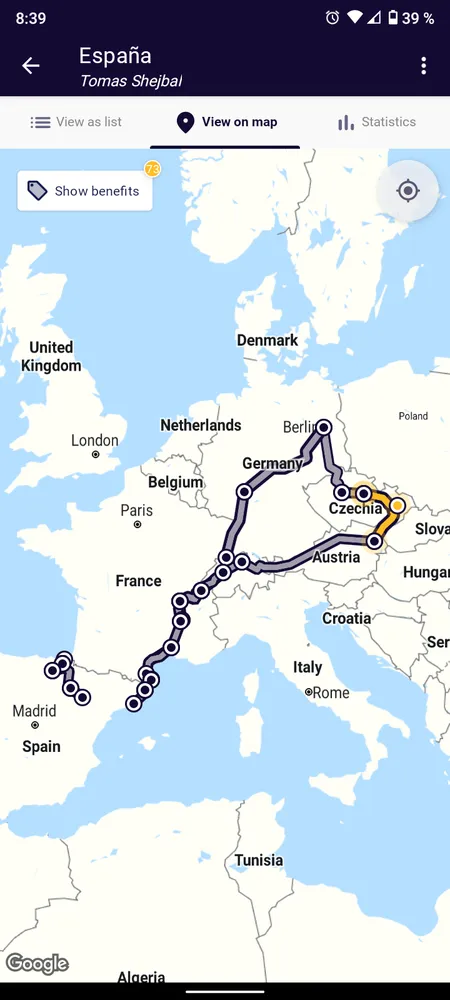
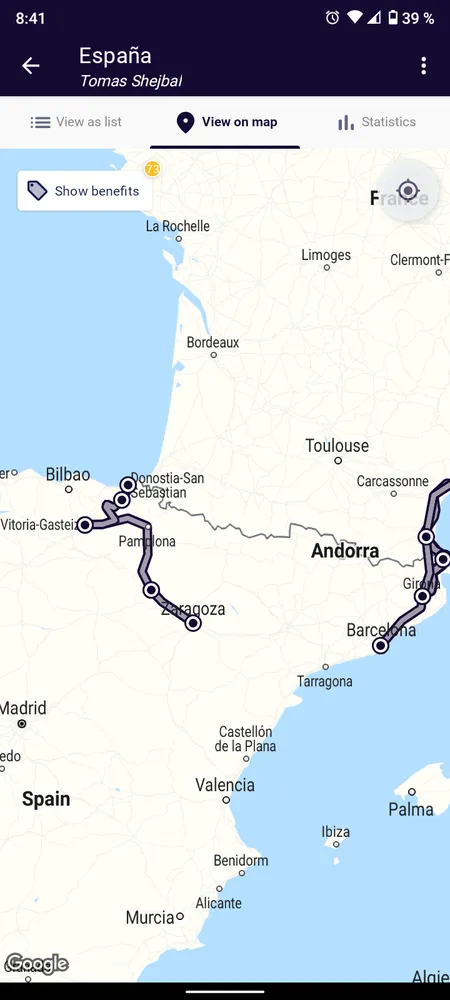
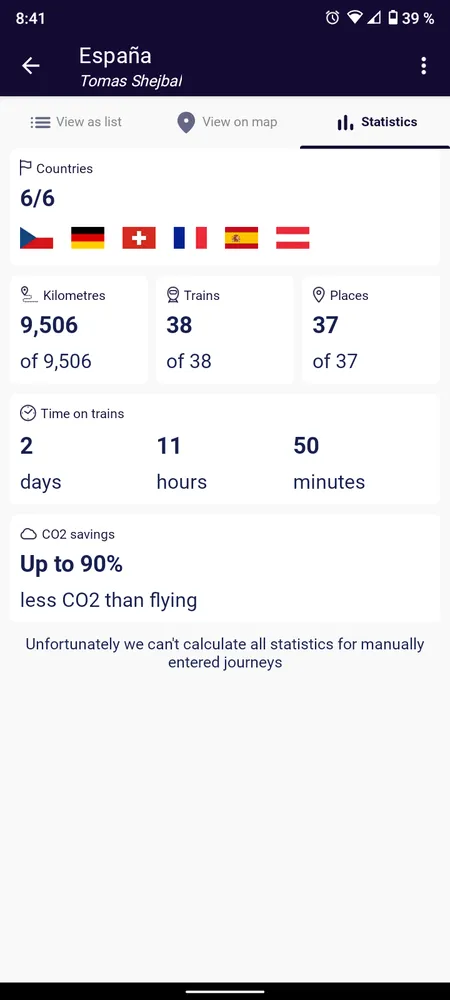
Reasons for traveling to Spain by train in bullet points
Besides the reasons mentioned above, also several others, and I'll continue criticizing buses and cars:
- I perceive trains as more free.
- Train stations are usually very close to city centers, longer transfer times can be used for quick city visits. That's not possible with flying.
- No need to be at the station too early. No security checks (except one for high-speed trains in Spain).
- While watching the landscape and listening to music, lots of ideas come to me. Suddenly I'm in some pleasantly dreamy state where many ideas come.
- Similarly at night, when I'm teetering on the edge between wakefulness and sleep (I have lots of notes - you have something to look forward to!).
- By car I'd have to drive and look ahead for 24 hours of driving, maybe occasionally glancing at grassy slopes where the highway is embedded. In cities I'd deal with parking and such...
- Buses are too tour-like, you can't move around in them, people are too close together.
- A bit of CO₂ savings. I don't know, but CO₂ from travel doesn't really bother me that much. "How so? You deal with ecology on your blog?" I hear questions. CO₂ and travel. That's a topic! I have it this way: on trips I learn and discover. Lots of ideas come to me, I rest. Then I can continue creating freshly. For example, thanks to a trip to India I gradually reduced meat to zero. Someone might shout about how much CO₂ that trip produced... is one flight more, or a permanent change? I'm for change! Feel free to write in the comments how you see it. Oh and I occasionally plant a tree or pay someone to do it for me.
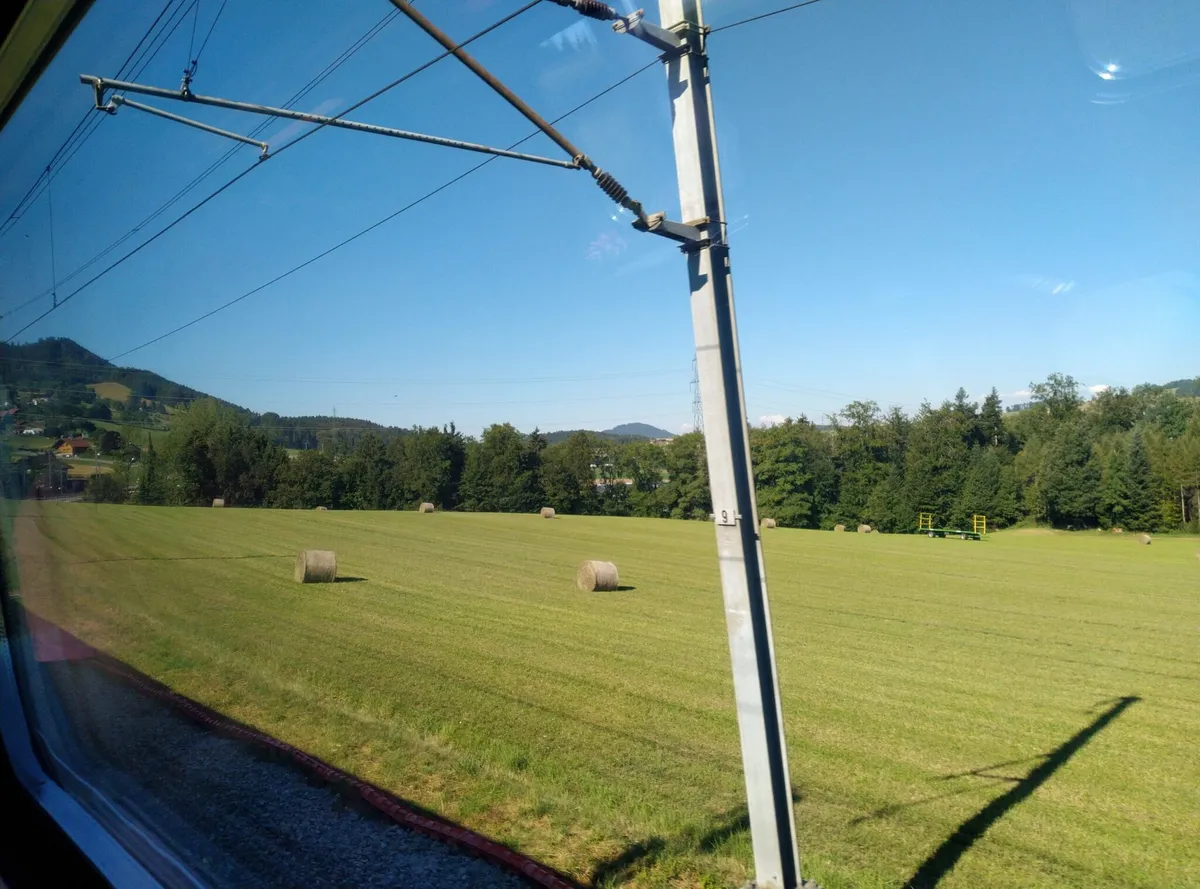
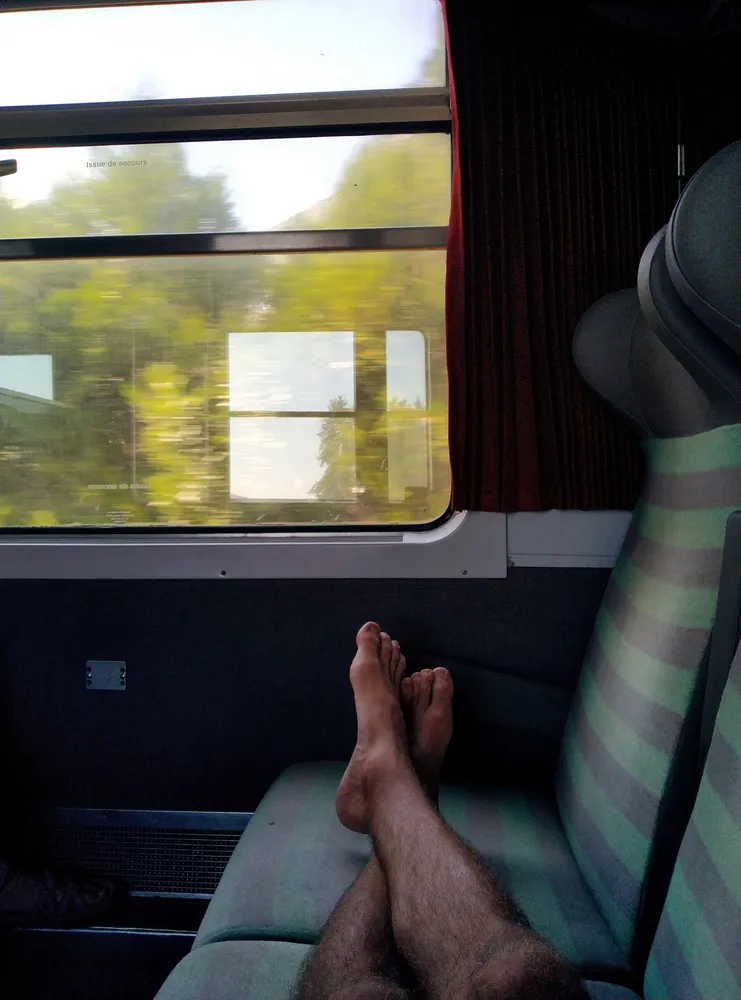
Besides being more time-consuming, train travel also requires disproportionately more planning. If you're considering setting off somewhere by train, then in the next chapter you'll be purring with delight from the provided information (don't mention it!).
How to plan a train trip to Spain?
Generally
Getting to Spain by rail isn't completely simple. Especially when planning the trip a month in advance and traveling in August - probably the worst possible month for traveling around Europe (but mandated vacation mandates).
If I compare the trip to Girona with, say, Split (direct train - although Tomáš Hajzler doesn't have a very positive experience) or Rome (one transfer in Vienna, without my or anyone's experience), when traveling by high-speed trains you transfer at least 4 times and it takes about 24 hours.
High-speed trains go fast, but usually connect major cities that (unlike regional trains) don't follow an imaginary direct route. Therefore the time difference when using regional trains isn't that big (about 6 hours more), just the number of transfers increases (about 12 trains). However, the financial savings are significant, because high-speed trains in France and Spain have mandatory seat reservations and especially in August when planning a month in advance they're often booked. And a month in advance it's not even possible to make a reservation for a Spanish train - I'll get to that.
To Spain by train with the Interrail Rail Planner app
After purchasing a Global Pass from Interrail, it's good to download the Eurail/Interrail Rail Planner app, with which you can plan connections, find out if reservations are needed for given trains, and last but not least, prove to conductors with a QR code.
The QR code is one for the entire trip and below it only departure and arrival stations appear (according to current time). So the conductor only sees whether the Global Pass is valid after scanning the QR code. Some conductors also looked to see if we had the connection listed in the app.
Note: In areas with slow data, the app loads the QR code "infinitely" long. However, if the phone switches to airplane mode, then the QR code displays immediately.
The app is good for finding connections on trips, but for planning a trip it's better to use a browser and the ability to have multiple open tabs next to each other. I don't recommend idos, you can easily get burned with it. If not idos, then what?
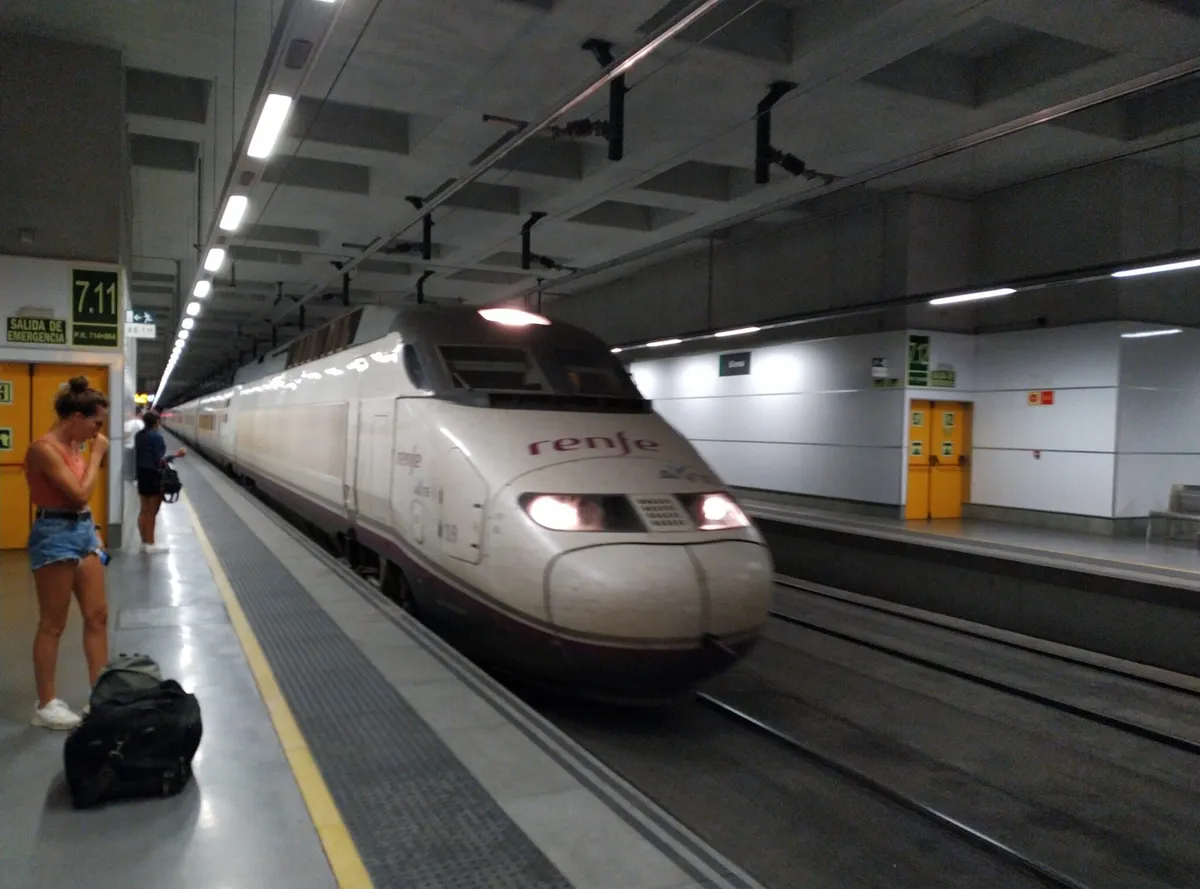
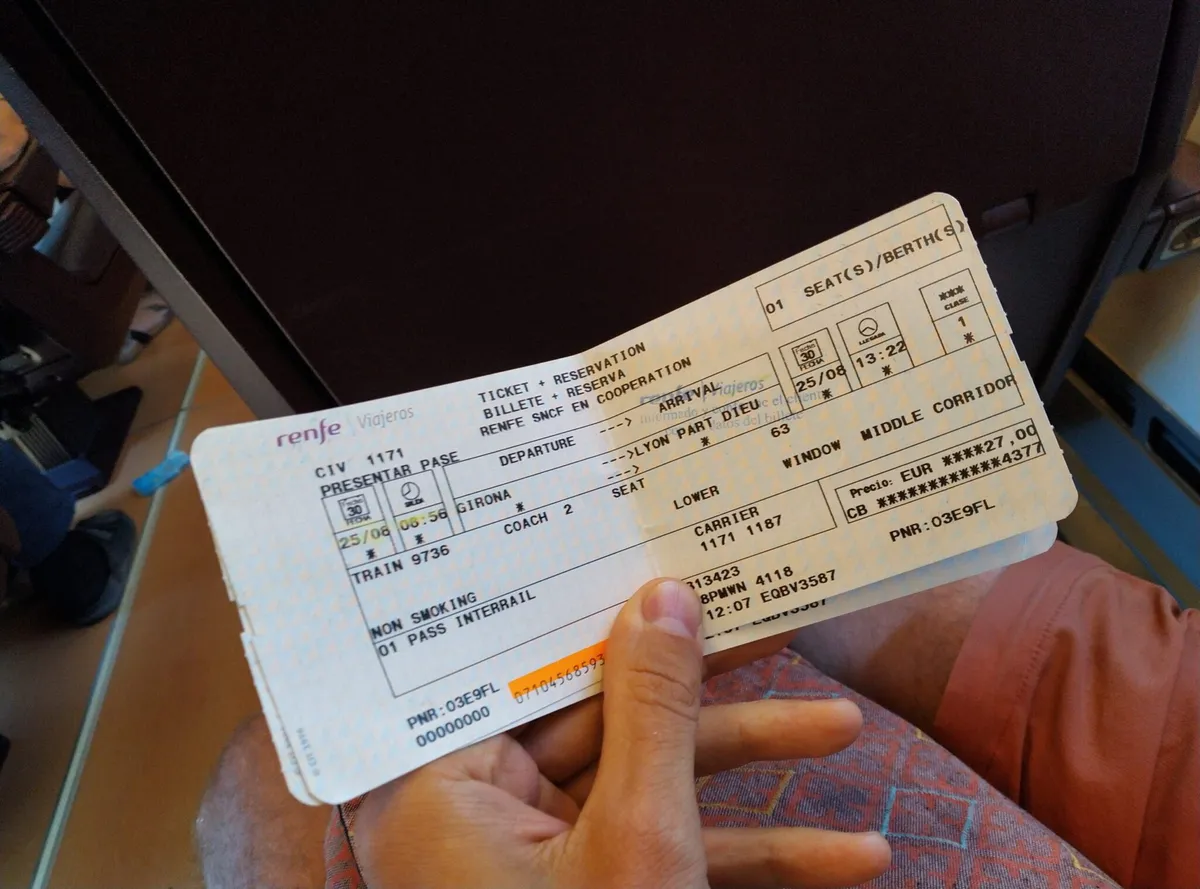
Searching for connections
Not only for planning a train trip to Spain, I recommend using the search engine of German railways. For Spanish trains it worked even better than the domestic Renfe. I also downloaded the DB Navigator app, which I used during the trip.
In the German search engine you can turn off high-speed trains, set minimum times between transfers and much more. You can thus quite comfortably plan the entire trip from one place. The biggest problem is however in reservations. These can be excluded, which however stretches the journey. The result was therefore a compromise between time and the price of reservations.
To Spain by train without idos! At first I used our idos for searching, which works well for us. After entering Pardubice - Barcelona, it did find a connection, but for one train in Austria it listed the arrival time two hours earlier than reality. Thus idos planned connecting trains regardless of the fact that the train had an actual arrival after the departure of the connection😀
Reservations
Here I got burned right at the start. I found a night train from Vienna to Munich, reserved two seats through Interrail (there's a 4€ fee per reservation - couldn't make a reservation through ČD, same with OBB) and planned further. Subsequently I found out that the next day we couldn't move through France without a reservation.
The reservation was naturally non-refundable. So I proceeded in reverse and completely abandoned the route through Paris that I originally planned. Instead I chose the route through Switzerland, which is definitely more economical regarding reservations and you don't need to fear transfers in Switzerland. Plus the views from the windows are breathtaking.
Because I left all the planning until July, it wasn't possible to make a reservation for the Lyon-Barcelona high-speed train. That's quite crucial, because with regional trains (which we ended up taking), the journey stretches and there's also a need to sleep somewhere along the way.
The mentioned high-speed train was operated by Spanish Renfe - which is absolutely crucial! The Spanish namely don't support online reservations. This can still be circumvented through Interrail, but the Spanish insist on sending physical proof of reservation by post. For this reason they force travelers to reserve seats at least 6 weeks before train departure!
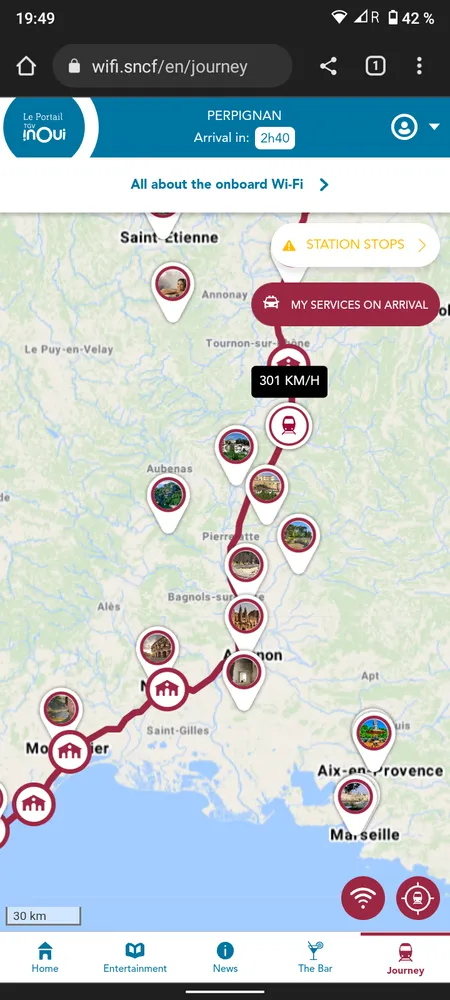
How did we actually go to Spain by train?
Journey to Spain
The itinerary for the train trip to Spain (July 29, 2022) looked as follows:
| from | departure time | to | arrival time | journey length (according to timetable) | reservation cost (per person) |
|---|---|---|---|---|---|
| Pardubice | 14:09 | Prague | 15:22 | 1:13 | 35 CZK (optional) |
| Prague | 16:25 | Berlin Suedkreuz | 20:35 | 4:10 | 75 CZK (optional) |
| Berlin Suedkreuz | 21:35 | Frankfurt (Main) Hbf | 02:11 | 4:36 | 75 CZK (optional) |
| Frankfurt (Main) Hbf | 02:45 | Basel Sbb | 6:20 | 3:35 | - |
| Basel Sbb | 06:25 | Bern | 7:26 | 1:01 | - |
| Bern | 7:34 | Geneva | 9:18 | 1:44 | - |
| Geneva | 11:30 | Lyon Part Dieu | 13:24 | 1:54 | - |
| Lyon Part Dieu | 15:20 | Valence Ville | 16:32 | 1:12 | - |
| Valence Ville | 18:13 | Valence Tgv Rhone-Alpes Sud | 18:20 | 0:07 | - |
| Valence Tgv Rhone-Alpes Sud | 19:27 | Nimes | 20:11 | 0:44 | 10 €(mandatory); airbnb in Nimes |
| Nimes | 12:14 | Port-Bou | 15:45 | 3:31 | - |
The last row shows the connection we were supposed to take to Spanish Port-Bou (on Sunday July 31, 2022). However, it ended in Perpignan. Why, you'll find out in the next chapter. Because of this, the continuation of the journey looked like this:
| Nimes | 12:14 | Perpignan | 14:48 | - | |
|---|---|---|---|---|---|
| Perpignan | 15:55 | Cerbere | 16:31 | 0:36 | - |
| Cerbere | 18:04 | Port-Bou | 18:08 | 0:08 | - |
| Port-Bou | 18:39 | Girona | 19:42 | 1:03 | - |
Journey back to Czech Republic
The journey back was much smoother, because we made seat reservations at the counter a few days after arrival for AVE (high-speed train) Girona-Lyon (remember how I said it can't be done online?) and thus avoided several regional trains in France.
The itinerary for the train journey to Czech Republic (August 25, 2022) looked like this:
| from | departure time | to | arrival time | journey length (according to timetable) | reservation cost (per person) |
|---|---|---|---|---|---|
| Girona | 8:56 | Lyon Part Dieu | 13:22 | 4:26 | 27 € (mandatory, but first class, because there was no space left in 2nd) |
| Lyon Part Dieu | 14:38 | Geneva | 16:35 | 1:57 | - |
| Geneva | 16:42 | Zurich Hb | 19:28 | 2:46 | - |
| Zurich Hb | 21:40 | Wien Hbf | 6:34 | 8:54 | 12 EU (mandatory) |
| Wien Hbf | 8:10 | Hranice na Moravě | 10:30 | 2:20 | 75 CZK (optional) |
| Hranice na Moravě | 11:31 | Pardubice | 13:43 | 2:12 | 75 CZK (optional) |
How to move around Spain by train?
Interrail works on all connections from Renfe and also Renfe Cercanías, which are suburban trains. In Catalonia, Cercanías are called Rodalies, but it's the same thing. I installed the Renfe app, but didn't use it for anything. However, I used the Renfe Cercanias and Rodalies de Catalunya apps extensively - you can search train connections in them that other search engines can't reach.
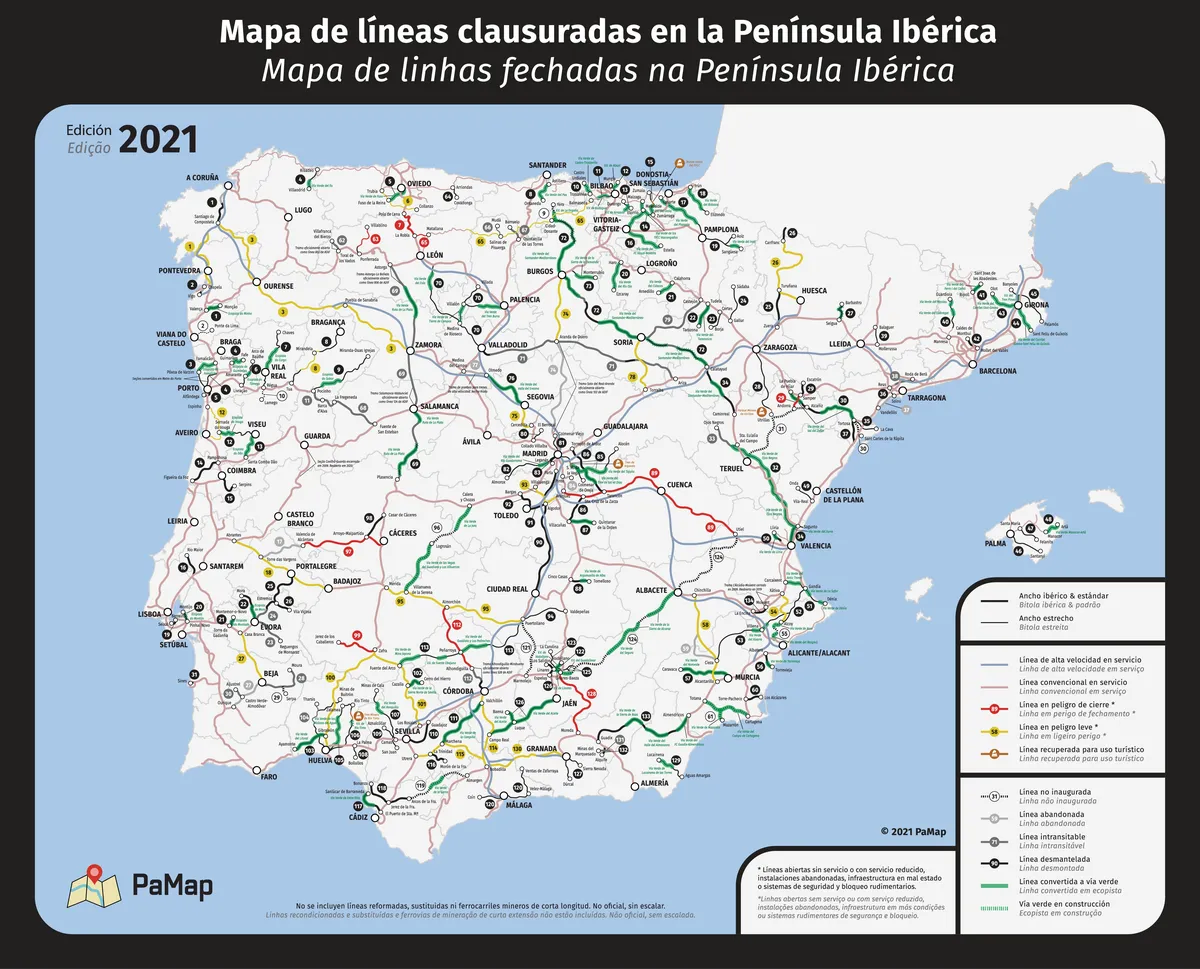
With Cercanías we encountered a problem when using Interrail: most turnstiles only read tickets with magnetic strips. QR codes were only read by turnstiles at Barcelona-Sans station. So we had to contact staff/security every time. They either pressed some magic button and the turnstile opened, or gave us a ticket with a magnetic strip that the turnstile ate and let us through. Several times we called information and someone opened the turnstile remotely. But once it happened that no one opened it for us.
Basque Country - euskotren
In the Basque Country, Renfe operates, but only between Vitoria and Bilbao and also between Vitoria and San Sebastian. There are however other tracks - between San Sebastian and Bilbao, where suburban euskotren trains operate, but Interrail doesn't work on them. You need to get a Barik card, which is also valid for metro in Bilbao and generally public transport in Bilbao and San Sebastian. The Barik card costs 3€, but pays for itself in two or three rides. Moreover, multiple people can travel on it simultaneously (just touch the turnstile as many times as people are traveling). You can top up via mobile phone with NFC.
What were the travel costs?
We bought the Interrail ticket with unlimited validity for 30 days in May, when it was sold with a 50% discount. Even so it came to 344€ (about 8500 CZK per person). With all reservations the monthly train travel thus came to 10500 CZK per person. Except for two bus transfers and traveling around Bilbao with the Barik card (+2000 CZK per person), Interrail covered all trips. Total for travel per person therefore 12500 CZK.
Honestly, I don't care if the trip was more expensive or cheaper than airplane or other forms of transport. I wanted to go by train, as I already wrote above 🙂
Cost comparison of train travel vs. airplane and car
However, for those who like numbers: last year we flew in August by plane from Pardubice to Alicante, from where we moved to Valencia and surrounding area. Just the ticket with a low-cost carrier (we flew only with carry-ons) was 6700 CZK. Just car rental for 7 days came to 10000 CZK. Then there were some train trips (together 1200 CZK). Last year's costs for travel thus came to 12300 CZK per person. Now we were traveling for 28 days, last year only 14, so half.
If we had gone by car, we would have driven about 4800 km (counting only transfers, not smaller trips at destinations) -> 48 (hundreds of km) x 7 (average consumption of our pet on the highway) x 45 (price per liter of gasoline), we get 15000 CZK for gasoline (however for both), without highway tolls, insurance, parking, etc.
Various variants (and thus prices) of Interrail tickets
The ticket price may thus at first glance seem excessive, but it depends on its further use in the destination and some planning, because Interrail offers various ticket variants (as of the date of writing the article), which are interesting even without 50% discount:
- 15-day ticket valid for a month for 332€ (7900 CZK) - that would almost suffice for us too - we traveled 17 days within one month.
- 7-day ticket valid for a month for 251€ (about 6200 CZK): then 4 days would fall on the journey there and back and 3 days on transfers around Spain. For closer destinations it could be used even better.
- 4-day ticket valid for a month for 185€ (about 4500 CZK): just transfer to Spain and back.
Good to mention
Watch out for Switzerland and long live mobile credit!
Well, I didn't read this SMS and in the blink of an eye lost 300 CZK of credit. Hooray, if I didn't have credit...!
Welcome to Switzerland. Calls to CR and EU cost 35.00 CZK/min, receiving calls 18.00 CZK/min, SMS 9.60 CZK, MMS 16.60 CZK. Internet connection costs 75.00 CZK/MB (we charge it per 10 kB). You have the Data roaming limit service enabled. For calls to CR use prefix +420, e.g. Customer center: +420738333333. Listed prices include VAT.
Toilets in Switzerland
In Switzerland you pay for physical needs and not little. Basel and Bern for 2 CHF (about 50 CZK). Zurich even 2.5 CHF. You can't pay by card. In Zurich however it's enough to go in front of the station, where there are public toilets for 1 CHF and you can pay by card. Locals even pass doors to each other.
Delays on journeys
There were delays, but the biggest problem was hitches in France - see below.
- Anyone who traveled by train in Czech Republic this year knows that delays of tens of minutes are daily bread.
- I was surprised that even in Germany - in the night train from Frankfurt to Basel we waited an hour (departing from Frankfurt), without anyone informing us why we were standing.
- In France 20-minute delays were not uncommon.
- But in legendary Switzerland we had the biggest delay of 3 minutes and only once. Otherwise always on time and once the train even left a minute early.
- In Spain, where we spent the most time, delays were commonly up to 10 minutes.
Complications on French railways
Weekend July 30-31, 2022 there was a strike on French railways. Of course we didn't know. We only found out on the Nimes - Port-Bou train. Already on the platform it seemed strange that the train was only listed to Perpignan (the train number matched).
During the journey I googled and found that most high-speed trains on the route were cancelled and regional trains ended in Perpignan. Buses naturally fully booked, blablacar too. So what? Another accommodation in France? Veronika already felt Spain in the air (she reveres Spanish language and Spanish culture while resisting French) and was willing to do anything to not spend another night in France.
Perpignan -> Cerbere
I searched for options. I found a regional train that went along the coast to Cerbere - the last village before the first Spanish village (Port-Bou), about a kilometer as the crow flies. On mapy.cz there was even a marked tourist trail, about 3 km long, just with a hill between France and Spain. The hiking app estimated one hour. I didn't really want to, it was warm and mainly it was about principle! We wanted to arrive in Spain by train, from which we were separated by 1 km as the crow flies! But Veronika grabbed onto the possibility and no longer intended to give it up.
Cerbere -> Port-Bou
After arriving in Cerbere I just habitually looked at the departure board and found information that the Spanish side was sending an extraordinary train due to strikes, just for the Cerbere - Port-Bou connection. It was supposed to leave in an hour. Since Cerbere lies by the sea, such waiting can be endured quite well by us seasiders (see photo on the right). And the hour-long route over the hill shrank to 8 minutes by train, mostly through a tunnel.
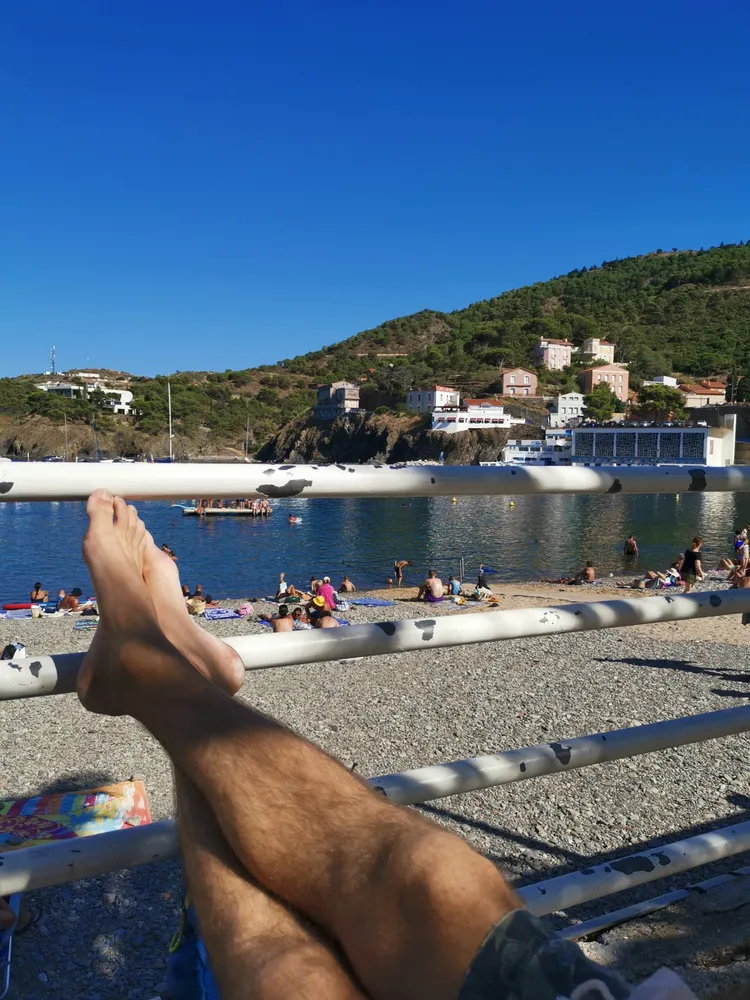
I thus fulfilled my dream - I arrived in Spain by train! And thank you Veronika for not being scared of the railways and going into it with me!😋
What about setting off by train to Italy?
Coming out: flyers, insolvency and the journey to zero waste
Through my own example of the journey to zero, I show how to live without waste, lighter and with fewer things. However, the journey to zero hasn't always guided my steps... this article was prompted by the arrival of a letter from the distant past. Although it's been 11 years, it's as if I'm looking at a different person. Which is good. What doesn't grow, dies.

Last updated: August 24, 2023
My steps weren't always guided by the journey to zero
For about six years I've been avoiding supermarkets like the devil avoids the cross. For the last six years I've been shopping in package-free stores and leading a zero-waste household together with Veronika. It brings treasures, the biggest of which is probably life's lightness.
However, there was a time when supermarkets didn't bother me. On the contrary, I liked their anonymity and didn't like small shops. I was bothered by the contact with salespeople, exactly what I enjoy today. What's more, I served supermarkets...
But that seems so long ago to me now... I was living with my parents then...
And after 11 years, the court's claws found me
This week I'm watching my parents' cats. When I was emptying the mailbox, there was a summons from the court. I laughed: "What are my parents up to?" But karma found me quickly. As soon as I pulled out the letter, I was staring at my own name.
"How's that possible? I have permanent residence in Pardubice and even a data box," I shook my head in confusion.
The materialization of all those emails where Uncle Sam died and has no heirs
Today I called the registry office. It turned out the court doesn't want to convict me, but to give me a gift. Cool!
The company that contacted the court only gave them my address. Nothing more. No date of birth or anything more specific so they could find me in the population register and find out if I'm still at that address or if I have a data box.
Coming out
It's time to come out with it... it's been bothering me for years. I can barely sleep anymore... inhale, exhale:
"I delivered flyers throughout college!"
It's as if someone lifted a boulder off me. The weight on my Solar Plexus is gone. Phew.
But that's how it is. For five years I delivered flyers. During those five years I delivered flyers for three companies. For a while even simultaneously. Life is sometimes ironic, isn't it? 😀

The journey to zero starts with the sign "no advertisements." Does it make sense?
I used to love these mailboxes. They saved me work. However, let's say what the reality was... and I'm not proud of it.
If you think that by sticking up a "no flyers" sticker you'll make a dent in the world...
After delivering flyers, you had to report distribution success and flyer rejectors. However, I still received the same number of flyers, I just had to return the remaining flyers (when they were no longer valid) when picking up new ones. But reporting rejectors was a damn administrative process. In the first years, such addresses were dictated to a telephone operator, only later did they switch to online table filling. Then inspections came, ringing people and asking if they were getting flyers... what a mess.
However... the reality was that reporting was ignored and what remained was eventually taken to paper collection, where there were extra bucks for it. Except for 2008-2010, when due to the automotive industry crisis, purchase prices even went into negative values. Apart from those years, they paid 2 CZK/kg. In a quarter you could collect even 200 kg.

Want a goat for your mailbox too? Write to me through the contact form and I'll send it to you. You don't even have to register anywhere, but you can, of course, because my newsletter with curated content is full of interesting stuff!
However, I knew people who went straight to paper collection with them. That didn't work in my district. There they demanded the flyers back. 😀
So "no advertisements" has no value?
It probably does. Just maybe not as much as one thinks.
Insolvency
After five years, that original company I delivered for twice a week changed owners and soon stopped paying. It ended up in insolvency. I didn't like that. It wasn't so much about the money as about the principle. Nobody's going to screw over an electrical engineering student!
I took the trouble to register for the insolvency proceedings. It was about an amount between 2500-4000 CZK, I don't remember exactly.
So here's what we have after those years with interest...
Something was recovered from the company after eleven years and divided among others who were as active as me. Apparently there are 300 of us. So, the amount is: 11 crowns and fifty hallers. No kidding. 😀 The coincidence of eleven years with eleven crowns is interesting.
It's not about the money, I've naturally forgotten about it long ago. It's more about the fact that because of 11.5 CZK, a bunch of people at court have to deal with this case. Paradoxically, it's easier for the clerk to complete the proceedings with me and pay me 11.5 CZK than to simply ignore it. The whole time she'd have to watch whether I'd registered a claim for those 11 crowns, and after 4 years she'd inform me that the dizzying 11.5 had fallen to the state.
Gratitude for the reminder of where the journey to zero has led me
I feel grateful for the reminder of where I was eleven years ago. As I wrote above, I'm not proud of it, but I don't blame myself for anything either. It's part of the story. I'm sharing this text so that part of the journey is visible. The journey to zero.
I'll be away for a while now. Probably more than a while. So the next post in a month. ¡Hasta pronto, amigos!
Package-free store and how to shop there?
On package-free stores. Significant relief on the journey to a zero-waste household.
I most often get these questions: how do you shop in such a package-free store? What can you even buy there? And isn't it more expensive than regular stores? I'll answer the first two questions in this article, and save the last question for next time, where I'll thoroughly analyze it based on collected data.

Last updated: July 11, 2024
How to find out if there's a package-free store in your area?
What product range do package-free stores offer?
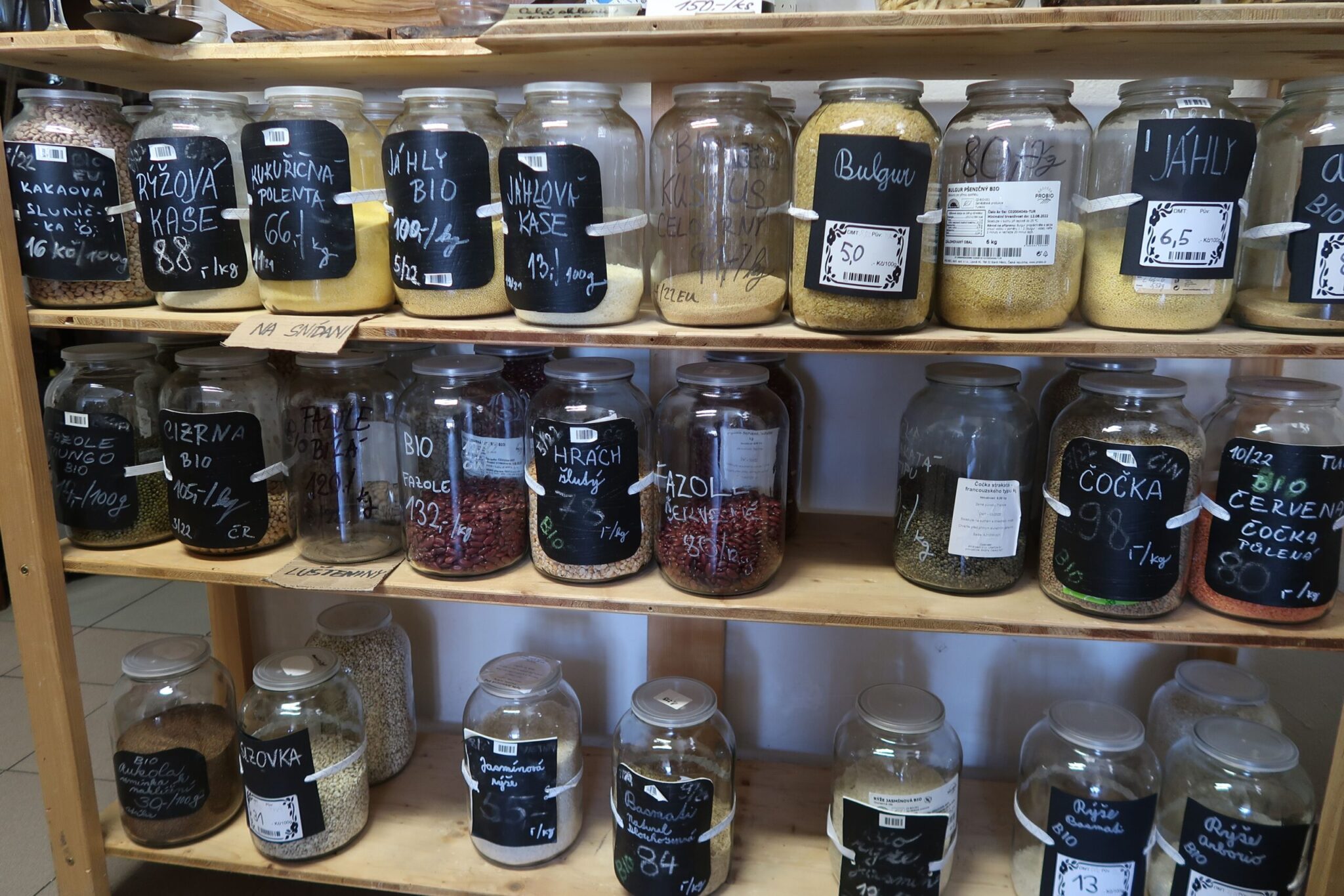
Package-free store and the actual shopping process
Types of stores
Preparing for shopping

The shopping process
Package-free store and the advantages of shopping there
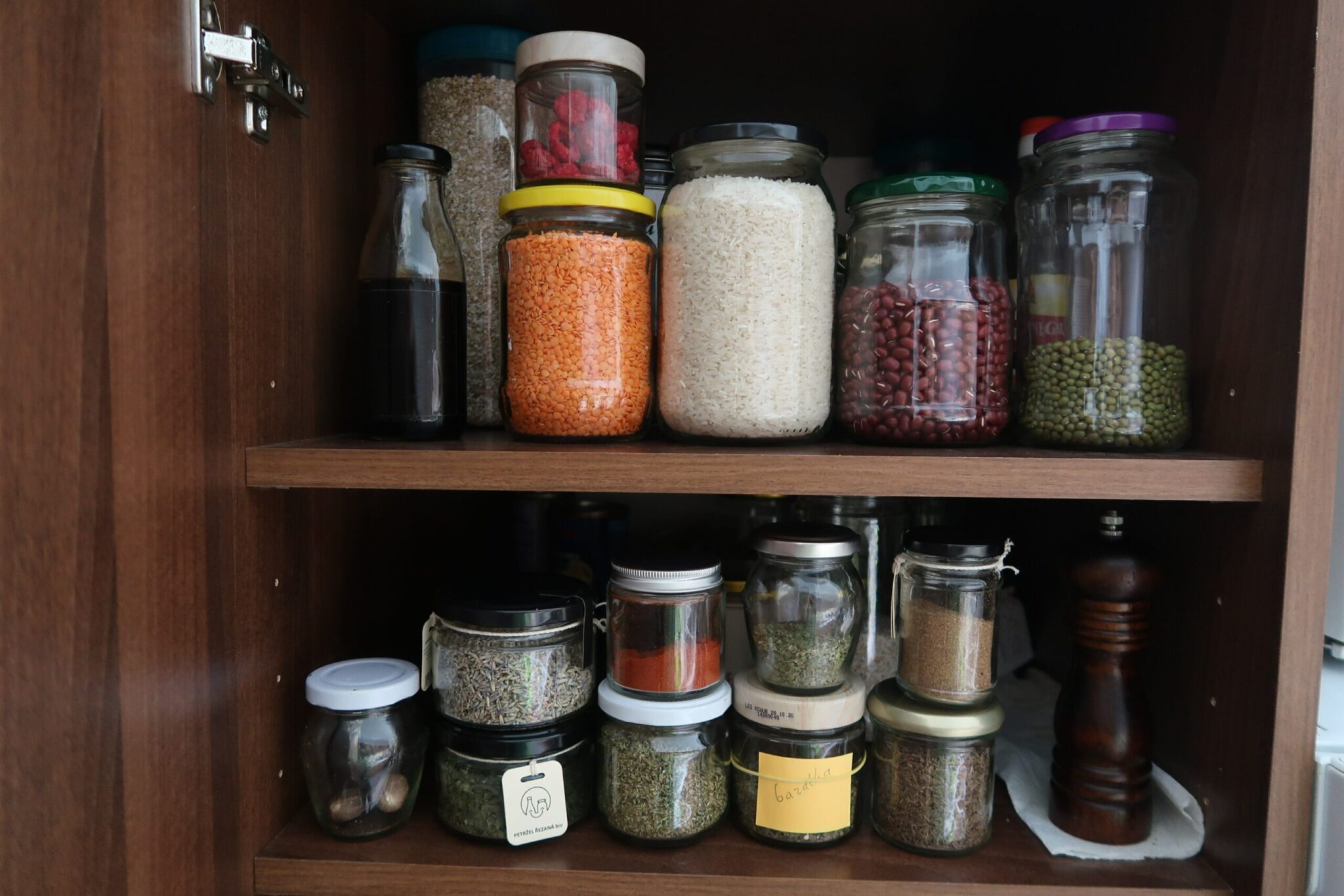
Disadvantages of shopping in package-free stores
Conclusion
Anonymous waste. Just don't spill the bin on the way.
Mixed waste hidden in a black plastic bag from prying eyes. That's anonymous waste. That's municipal waste, the reality of our everyday waste management.
How did I come to this? This morning I witnessed a brief moment that forced me into deep reflection (you know me).
November 4, 2022
A scene on a rainy street
I was standing with tea by the window watching the rainy street (a habit from England). I saw garbage collectors emptying bins. At one point a "stylish" thirty-something woman rushed over to them and with a smile handed them a bag of garbage, as if she was doing them some kind of favor. When the bag landed in the truck, it clinked all the way to me (through the closed window).
It occurred to me that this is actually the only moment when a person might feel ashamed of their waste. Otherwise, waste is anonymous. That's why we throw absolutely anything into the bin. Nobody knows about it. Nobody judges us for it! And the judgment of others is like a steel ball chained to the leg for many of us. But imagine if it weren't like that. If you had to take your waste to a collection center, like hazardous waste.

The lady would first want to see the contents, that's clear, and of course also see your ID. We'll call the "stylish" woman (from the beginning of the article) Silva.
Silva arrives - a story where anonymous waste doesn't exist
Silva drove into the waste collection center with her shiny SUV. She wanted to arrive just a few minutes early to avoid the queue. Not so much the queue in front of her, but rather the queue of cars that were starting to appear in her rearview mirror.
Two cars that had arrived earlier disappeared and Silva's turn finally came. She got out of the car and pulled out an anonymous black bin for mixed waste from the trunk.
"ID card, please," asked the woman in a torn, dirty jacket. Silva handed her the ID with a nervous smile. She couldn't help it, but these visits always seemed extremely unpleasant to her.
You don't sort glass?!
It didn't happen very often that Silva would feel ashamed of herself. At the collection center, however, it happened with iron regularity: every Monday and Thursday.
"Oh!" the woman in the jacket raised her eyebrows, "you don't even sort glass? Can't you give up those pickles when you can't even be bothered with the jar?"
"One jar..." she heard an apologetic tone in her own voice. Looking at the woman, she noticed the carelessly pinned name tag: "Dita."
"One per week! That's fifty-two jars a year! Just from you! Who do you think has to haul this? I only have one back!"
A nightingale with a constricted throat
"I'll try to do better," Silva whispered and unpleasantly felt blood rushing to her face. She searched her memory for when she had felt like this last. It didn't take much effort.
Rays of fading sun penetrated through large windows from outside, the courtyard was covered with colorful leaves. And she stood with tears in her eyes in front of the podium.
"Just try it," the teacher urged her. She didn't understand that Silva was insecure and afraid. Mom had just told her that she couldn't sing. But little Silva didn't know that mom had a headache and the exclamation: "Who has to listen to your screeching all the time!" shouldn't be taken seriously at all. But little Silva was dependent on adults for her self-evaluation.
"Why else would mom tell me I can't sing if it wasn't true?" went through her head back then in front of the podium.
Under the teacher's pressure, she finally quietly recited two verses while swallowing tears as bitter as grapefruit, which she sometimes had to eat because it was full of vitamins. She sensed that vitamins were something good, but didn't understand why she had to eat something that didn't taste good because of them.
She got a C that time and convinced herself that she really couldn't sing. She never sang again. Ever.
Haven't you considered therapy?
"Hello!" the woman from the collection center waved her hands in front of Silva's face.
"Sorry, I remembered something."
"I'm saying, do you know what children in Africa would give for this?!" Dita sputtered angrily.
"I misjudged the amount of rice..."
"Then measure it next time!
Dita frowned over the 200g package of macadamia nuts but said nothing. But Silva could guess what she was thinking: "For a whole day of collecting waste, I can barely afford two packages like this!"
"Four wine bottles?! Haven't you thought about therapy?"
"We had a celebration."
"You don't need to lie to me. I'm neither your husband nor your boss."
Silva swallowed hard. What was she supposed to do? A glass or two in the evening helped her unwind from otherwise demanding work where the demands kept increasing.

Mixed municipal waste reveals the number of flare-ups
When Dita pulled out a solid plastic container from a product that promised losing 10 kg in one month, she said venomously, as if to herself: "The fat will be thin and the thin will be cold..."

Dita continued the inspection. Dandruff shampoos, creams for dry skin, but also anti-fungal ointments. A composition of food and drugstore items, worn-out pantyhose and one tangled condom.
"Just one?!" Dita's eyes widened, while thinking: "Those makeup and tight leggings aren't much use to you."
Silva, now completely red, could have slapped herself again. She wanted to throw it in the small bin in front of the house to avoid exactly such comments during the mixed waste inspection. Dita naturally couldn't know what Silva knew.
With tears in her eyes, she got into the car and a chain of doubts and assumptions from recent times went through her head. That one condom in the bin didn't represent defeat for Silva, but triumph. She wore heavy makeup and tight leggings to arouse her husband's interest, who had seemed indifferent in recent months. Not fifteen minutes passed without her thinking with anxious stomach tightening whether her marriage had hit a dead end. It didn't smell musty and of urine yet, but it seemed like the union was heading there...
Good thing we have that anonymous waste, right? Now just don't spill the bin on the way.
Sustainable household - that's the systematic Karel's way
Karel is pretty sharp. And also systematic. Karel simply likes to think analytically, which a sustainable household deserves. Especially at the beginning. Just no hasty or perhaps extremist solutions.

Last updated: May 17, 2023
Rummaging through trash? Not yet!
After coming home from work, the day after watching the documentary Gulf Stream, Karel set about analyzing waste and drawing conclusions. One would expect him to come to the kitchen, dump the contents of the bin on the floor and record what appears most often.
That wouldn't be a completely wrong approach, but Karel decided to think everything through properly. Somehow it seemed to him that focusing only on the trash bin might be too easy a solution. And as he knew from his engineering practice, seemingly easy solutions usually didn't work.
Instead of rummaging through the bin, Karel made himself green tea and sat down at the table. He put his phone in do-not-disturb mode, turned on music and listened to the song Maria by AlicebanD. Right from the start he heard: "...I have the power in my hands I have the thought, and it makes sense..."
Unnecessary things
That snapped him out of his brief daydream. He took a sheet of A4 paper, printed on one side with an invoice. He glanced over it briefly and chuckled: "New bike computer for the bike. I never mounted it... who knows where it even is."
He bought it when the old odometer still worked but was wired. None of his colleagues at work had a wired mileage counter on their bikes anymore. So he ordered a wireless one, but it didn't come with batteries. So he put it aside for a while. One evening when he was buying beer and chips at a convenience store, he noticed that the young Vietnamese guy also sold CR 2025 button batteries, which he needed exactly. He bought them, and while drinking beer he started setting units and time on the counter's display until he got to entering the wheel circumference. He went through the manual but couldn't find the table of common dimensions. He remembered that hassle with reading the wheel circumference and disgustedly put the counter away. This time for good.
Sustainable household: how is it possible to think about it?
"So... how to approach this sustainable household?" he looked at the blank page when he turned over the invoice. He took a pencil and drew a human figure. It wasn't a particularly sophisticated drawing. To capture legs, arms and torso, he made do with five lines and an ellipse for the head. Since the fish rots from the head, Karel also started with the head. He thought for a moment before making the first line leading from where the figure should have hair: mindset, attention.
The next line led from the mouth. He wrote next to it: what do we eat? From the simple question he made two more lines and wrote next to each: food preparation and shopping.
He circled the whole figure and started writing more and more words next to several quickly drawn lines, making more lines from them. Finally, around the little figure there was:
- Housing needs,
- fitness,
- clothing,
- hygiene.
The last line he directed to the center of the body with a simple note: excretion.

And since excretion is somehow where it ends for a person, we'll end today's article too.
Karel's tips:
- Did you notice that Karel uses the back sides of invoices for scribbling and breaking down thoughts and ideas? Similarly, you can use mostly non-recyclable receipts. They're great for daily mind maps or task lists, which you can gleefully crumple up at the end of the day after scribbling on them.
- What things could you get rid of? What's been lying at the bottom of your drawer for years? You can donate, for example, on nevyhazujto (don't throw it away). For selling, I prefer aukro. I haven't written an article about that yet, which I probably should. 🤔
¡Hombre, let's talk! Guy's grumbling about unnecessary packaging
Spain (how to get to Spain by train), sun, sea and mountains. Olivas y aceitunas, vino rojo y blanco and dark-haired señoritas with dark eyes. Markets, fresh vegetables, fruit, queso de cabra, but if there isn't any I won't turn down cow's cheese either. Empanadas, pan de pasas... ¿Bolsa? What? No, no necesito bolsa. ¿No me escuchaste, hombre? I really don't need a bag... hmm, great. ¡Muchas gracias, no! All I can do is grumble about unnecessary packaging. Or is there another way?

Last updated: September 13, 2023
Compostable bags in supermarkets
Yes, I often couldn't avoid supermarkets (mostly) in Galicia. In the Czech Republic I avoid temples of consumption (when I'm not delivering flyers), but when traveling it's hard to plan where I'll be at what time, whether local tiendas will be open, or if there will be any at all, right? So perfection goes out the window.
Supermercados naturally sell quesos at the chilled counter. They wrap the cheese in waxed paper and then without hesitation wrap it in a compostable bag. They stick a price label on it. Not even a virus could get through. ¡Salud!
But what to do with that compostable plastic bag? There's a pictogram on it saying shoppers should throw it in the orgánica after use. And it serves its purpose very quickly. It's thinner than regular plastic bags and usually doesn't survive removing the price sticker. Which you absolutely must remove (unless you plan to just look at the contents), because it guards the knotted opening.
But how is the poor españolito supposed to figure this out? For decades they've been told not to throw plastic bags in general waste but in the yellow container. Now, when they're finally acostumbrado and collecting good feelings one after another for their sustainable/ecological/great/exemplary behavior (from throwing away dozens of plastic bags daily), they should suddenly throw "plastic bags" in bio-waste? ¡Que va!
The supermercado manager would naturally object that it's a step toward sustainability and remind us that when a compostable "plastic bag" gets into nature, it will (and they won't even be lying here) harmlessly decompose over time. But still... do we really need to wrap everything five times in plastic when your own mesh bag or box would solve it? Maybe something like a reusable box, if not your own.
Cuddling empanadas with croissants forbidden
In small bakeries, cheese shops, fruit stands etc., they're very eager. Credit where credit's due, but there's just too much of that enthusiasm. Must be the temperament?
My own mesh bags work fine, but suddenly when weighing, the staff skillfully tosses the mesh bag into a plastic bag. When the staff is slow, I try to stop this disaster. But the salesperson just smiles and with the faith of someone providing above-and-beyond service, tells me: "Mejor así". Yeah, I must be crazy for not wanting that extra bag. When the hombre is giving it to me for free!
In the bakery they stuff each type of pastry into a paper bag. As if that fragrant French elegance (croissant) doesn't want to snuggle with a lovely fragrant little empanadita. As if sweet bread (pan dulce - pan is Spanish for bread/pastry of all kinds, pan dulce is sweet pastry) doesn't want to be with whole grain bread (pan integral).
Señor, what don't you like? The bag is paper after all! ¡Venga, hombre! That's replacing one package with another. ¡No, cálmate! I don't need it in a plastic bag too, I want to eat it right on the street!
Transforming grumbling about unnecessary packaging into action
When you constantly get more and more bags that you didn't ask for, that you often directly refused, soon there are more than un poco.
I pondered how to deal with this ecological catastrophe. There had to be a solution. I remembered a habit Veronika and I established in the Czech Republic. Whenever someone brings us a bigger plastic bag or we get something in one, we put it in a special container. When we go on a trip, we take it with us and fill it with trash we collect along the way.

This transforms negative into positive. So we've cleaned up several trails and beaches from bits of litter. It stopped bothering us that we don't always successfully defend against the plastic/paper flood of disposable packaging.
Note: dear reader, this doesn't mean you should now bury me in plastic bags!
A pretty good tip on how to store such waiting bags and plastic bags for their opportunity was shown to me by Gallego Nacho. In return, I showed him how to make oat milk at home.
Nacho is in the photo above, the fruits of his learning are in the video on the left.
A hug from being moved
I'm sitting in a panadería in the small coastal town of Noia when a guy comes in with a canvas bag for a baguette. The lady drops it in there like it's no big deal, he slaps a euro in her hand and disappears into the heat of the street.
I can't believe my eyes: ¡Un abrazo, compañero! I wipe tears of emotion from my eyes. I've finally found a kindred spirit! I smile and carefully sip from my cup of té negro. I disdainfully ignore the sugar in its paper packet, with a little cookie resting beside it in plastic foil.
How I Kept Postponing Getting Help
Today's post describes my search for physical activity after moving to the city, my tentative running beginnings, but most importantly my experience with postponing a visit to physical therapy and finally the visit itself. If you're currently deciding whether to seek help with anything, maybe this post will nudge you into action. Because: The worst decision is no decision at all.
Enough introductory words, let's get this story rolling. After moving to the city, I soon started thinking about what sport I wanted to do. When I lived in the countryside, I cycled. Quite a lot. But cycling in the city, especially if you live downtown, means getting out of the center and then back again at the end. That got old very quickly. Plus cycling is inherently time-consuming. So I started thinking about what kind of movement would work for me.
You'll run it off!
The fitness level from cycling wasn't a problem. It was clear I wouldn't transition from the more or less individual sport of cycling to team sports. I didn't have to think long about a similarly individual sport: so I cheerfully started jogging around the neighborhood and enjoying rapid progress.
My tight body, my aversion to stretching, and overly high expectations for myself cooked up their revenge pretty quickly. "You'll run it off!" I told myself two springs in a row, when that strange pain would always start in the front part of my leg between knee and foot, more on the outer side. It would end with me having trouble jogging across a crosswalk.
Yes, I blew out my shin muscles, two years running. I had no idea about their existence, just like I had no idea the word "shin" existed. I'd never had health problems before. That made it all the harder to admit I couldn't handle it. The punishment for not listening to my body lasted dozens of weeks.
But everyone runs!
"Everyone and their brother runs!" kept going through my head. "What am I doing wrong?" tormented me. I wanted to move somehow after a whole day at the computer, and running appealed to me. But when your body rebels? So I at least started swimming. But swimming has the disadvantage of people being around, which sucks for an introvert. Add hairy male butts that you inevitably glimpse sooner or later in the shower (okay, better than hairy butts of the gentler sex :D) and it's clear I wouldn't stick with swimming long.
So what about that running? During the year I naturally tried jogging and usually ended up after fourteen days in the same dead end. It was dark there, cold, I was alone and it smelled of urine and vomit from boxed wine. By the end of the year I gave up on running completely and waited for spring.
Admitting I should accept help
"Maybe I should go somewhere?" I dared to go that far in my thinking. "Am I really in such bad shape? Do I really have to go somewhere?" Well, so I finally ended up at physical therapy (YES!). I overcame my prejudices, swallowed that I was too healthy, young, proud, poor [feel free to fill in the blank, readers, let's be playful!], in short that I should accept help. And there, instead of a sour nurse, was a normal girl who didn't mess around from the very beginning.
We'd barely shaken hands before I was standing in front of her in just my underwear. She looked at me with this strangely evaluating gaze. I had no idea what this would lead to.
I could have read something about what to expect beforehand. I would have at least worn more appropriate underwear. Nothing against mom's Christmas gift: A cute beaver holding a gnawed log with the slogan "That's cool!" smiled confidently and surely made quite an impression. But I felt all the more awkward. What else made an impression during tricky exercises with loose underwear legs, I'd rather not think about.
And then it came! I hoped no one would ask me to do this, but there it was: "Please bend forward as far as you can."
Feeling special
Drops of sweat broke out on my forehead: "Well... I'm a bit tight..." I muttered unconvincingly. From her reaction, everyone says that. Probably from a sense of false modesty, so their performance wouldn't be judged too harshly, because she just casually waved her hand and said something like: "Yeah, who isn't. Ironically, I am too."
That I didn't mean it as just conversational filler, she understood very quickly: "Come on!" she urged me, not understanding that I was already performing my personal Olympic feat. I was actually quite proud of it: I touched five centimeters below my knees. Normal state was two and a half.
"Is that really it?!" she bugged out her eyes, "you call that SLIGHTLY tight?!" but I could hear from her voice that I still hadn't sufficiently convinced her. Unfortunately, this became apparent when she stood behind me, put her elbow on my back and tried to push. I squealed like a shot pig and a moment later I read pure surprise in her eyes. Dilated pupils stared at me in silent amazement.
Starting the fix
"I've never seen that before," she whispered after a good while. For a moment I basked in triumph, in feeling special, before realizing it would be better to hear that sentence in any other context, just not from a physical therapist.
Once the initial shock left her, she put on her professional face: "Don't worry, we can handle this!" she spoke again with that enthusiasm that otherwise stayed with her throughout the visit. She scribbled four papers (A4!) with exercises for home and scheduled the next check-up.
Then she had me lie down on the table. She touched my stomach. A red warning light went off in my head: "Uh oh, abs were never your strong suit, Tom."
"Hmm..." she immediately confirmed my fear.
Belly breathing
"Breathe into your belly," she instructed me and I just stared at her: "How do you breathe into your belly?" She gave me that uncomprehending look again: "Into your belly! Come on!" As if she needed to prove what rare material had arrived in her office. I had no idea what she wanted from me. If she'd told me to wiggle my ears, it would have been the same.
"Into the belly?" I repeated to myself... "how?" That day I was confronted with harsh reality. Suddenly, a few years before thirty, you discover you've had no idea how to breathe your whole life.
Gratitude
Today I'm infinitely grateful for the determination to go to physical therapy; for admitting that I needed to accept help. Back then it was stepping out of my comfort zone that paid me back more than I could ever have hoped. After over two years of unsuccessful attempts at running, in just four total visits I reached a state where the amazing physical therapist told me: "Okay. Now you know what to do and I don't need to see you anymore." That surprised me then, I imagined physical therapy lasted years. Wrong!
I did the recommended exercises about four to five times a week, learned to breathe into my belly, and slightly improved my tightness.
Thanks to the determination to let myself be helped and the will to change my then-miserable state, in the next article you'll be able to read why I actually run. Running forced me to go to physical therapy to learn how to breathe properly. My visit to physical therapy caused me to run for four years without interruption, in summer, winter, in heat, frost, rain, mud... Part of running was changing my diet... and the wheel keeps turning. I still run, without pain and with tremendous joy! There's nothing wrong with admitting a problem and letting yourself be helped! From my example you can see it works!